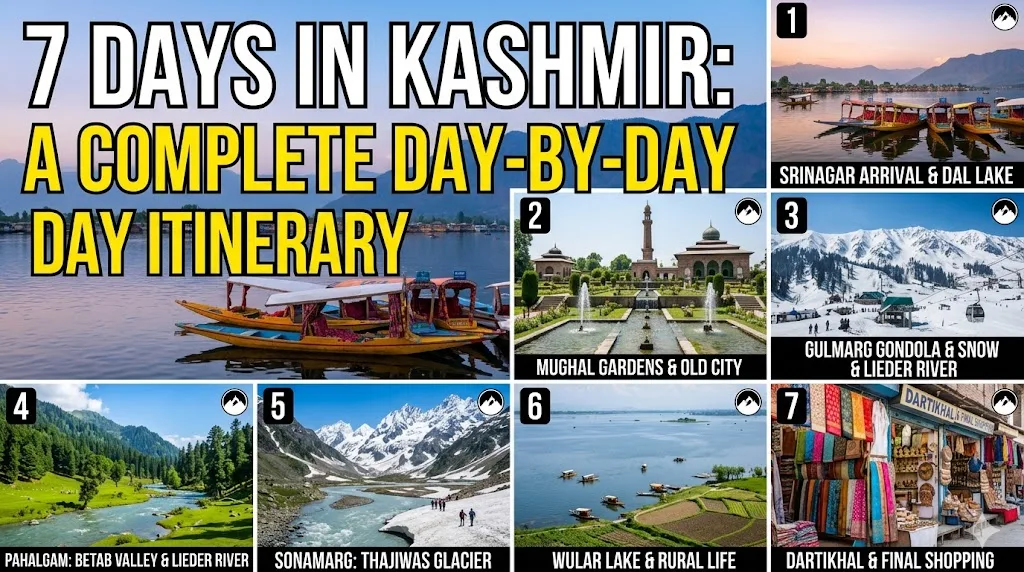
Seven days is the right amount of time for Kashmir. Five days covers the highlights but leaves you rushing. Ten days allows genuine depth but is more than most visitors can manage. Seven days gives you Srinagar, the three main destinations, one offbeat location, and at least two mornings where you have nowhere specific to be.
This itinerary is built for first-time visitors who want a complete experience — not a rushed checklist. It includes one night in Pahalgam and one in Gulmarg so you are not commuting from Srinagar every day. It covers all the major sites and leaves room for the unplanned hours that often become the best memories.
Before You Start — Practical Setup
Accommodation base: Srinagar (houseboat or hotel on Dal Lake) for nights 1, 2, 3, and 7. Pahalgam for night 4. Gulmarg for night 5. Sonamarg day trip on day 6 returning to Srinagar.
Transport: Hire a private cab with driver for the full 7 days. This is the most practical option — the driver becomes your guide, handles parking, and knows the roads. Cost: ₹3,500–₹5,000 per day depending on vehicle type and season. Total cab cost for 7 days: approximately ₹25,000–₹35,000.
Book in advance:
- Dal Lake houseboat: 4–6 weeks before arrival in peak season
- Pahalgam hotel: 3–4 weeks before
- Gulmarg hotel: 4–6 weeks before (especially in ski season)
- Gulmarg Gondola Phase 2 tickets: book online at etickets.jammukashmircablecar.com at least 3–5 days before your Gulmarg day
Day 1 — Arrival in Srinagar
Morning: Arrive at Srinagar Airport. Transfer to your houseboat or hotel on Dal Lake. Check in, freshen up, and take your first look at the lake from the deck.
Afternoon: Gentle first afternoon — a shikara ride on Dal Lake. Ask your boatman to take you through the floating vegetable gardens and toward the quieter inner channels of the lake. 1.5–2 hours on the water gives you a feel for the lake before the main sightseeing begins.
Evening: Walk to Lal Chowk and the surrounding market area. The evening bazaar near the clock tower is lively — good for orientation and a first taste of Srinagar street life. Have dinner in the old city.
Overnight: Dal Lake houseboat or hotel.
Day 2 — Srinagar Sightseeing
Early morning (7 AM): Start with the Mughal Gardens before the crowds. Nishat Bagh first — the twelve terraces descending toward Dal Lake are best in morning light. Then Shalimar Bagh (3 kilometres further along the lake road). Allow 45 minutes per garden.
Mid-morning: Shankaracharya Temple — the rocky hill above Srinagar with the best panoramic view of the city, Dal Lake, and the surrounding mountains. The climb takes 20–25 minutes. Go before 10 AM for clear visibility before haze builds.
Afternoon: Old city exploration — the lanes around Jama Masjid, the Shah-e-Hamdan shrine on the banks of the Jhelum River, and the traditional architecture of the older residential quarters. This is where Srinagar’s genuine historical character is most visible.
Late afternoon: Hazratbal Shrine on the western bank of Dal Lake — the white marble domed shrine is one of the most significant Muslim religious sites in Kashmir. The setting on the lake with the mountains behind is peaceful and architecturally distinctive.
Evening: Return to Dal Lake. Sunset from the houseboat deck.
Overnight: Dal Lake.
Day 3 — Tulip Garden / Srinagar Free Day
Option A (Late March–mid April): Visit the Tulip Garden on the slopes of Zabarwan mountain — Asia’s largest tulip garden, at its peak for approximately 2–3 weeks in April. Over 1.5 million tulips across dozens of varieties. Go early (gates open at 9 AM — arrive then to beat the crowds). Combine with a final walk through any Mughal Gardens you have not yet visited.
Option B (other months): Use Day 3 as a flexible day in Srinagar. Options: local markets for shopping (pashmina, dry fruits, handicrafts), a longer shikara ride through the full extent of Dal Lake, the Hari Parbat Fort above the old city, or simply a slow morning on the houseboat deck followed by an afternoon exploring areas you want to revisit.
Evening: Pack for Pahalgam the next morning.
Overnight: Dal Lake.
Day 4 — Srinagar to Pahalgam
Morning (7 AM departure): Leave Srinagar early for Pahalgam — the 95-kilometre drive takes 2 to 2.5 hours. The road follows the Jhelum River for much of the route. Stop briefly at Awantipora (35 kilometres from Srinagar) to view the 9th-century Hindu temple ruins visible from the roadside.
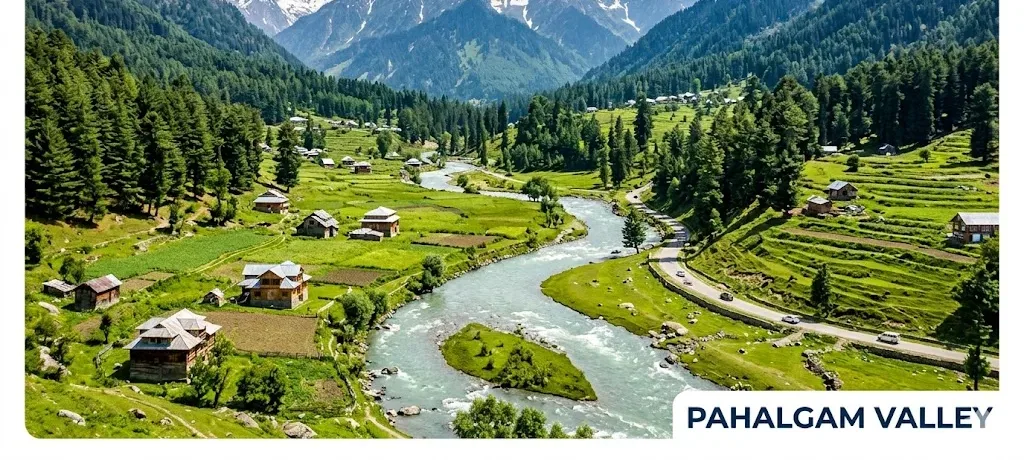
Mid-morning — Betaab Valley: Arrive in Pahalgam and continue directly to Betaab Valley (15 kilometres further). Arrive before 10 AM for the best experience — the wide meadow with the Lidder River running through it is at its most peaceful in the morning. Walk through the valley, sit by the river, take your time.
Afternoon — Aru Valley: Return from Betaab and take the separate road to Aru Valley (12 kilometres from Pahalgam town, different direction). This quieter, wider grassland is the starting point for Kashmir’s major treks. Walk into the valley for 30–40 minutes. The scale and openness of Aru is different from the more enclosed Betaab.
Evening — Pahalgam town: Return to Pahalgam town. Walk along the Lidder River embankment. The sound of the river running through the town is Pahalgam’s constant background. Have dinner at a local restaurant — try Kashmiri trout if available.
Overnight: Pahalgam hotel (book a room with a river view if possible).
Day 5 — Pahalgam to Gulmarg via Srinagar
Morning — Baisaran: Before leaving Pahalgam, take an early morning horse ride or walk to Baisaran — a meadow 3 kilometres above the town accessible only by foot or horse. The views from Baisaran looking back toward Pahalgam and the valley are among the best in the area. Leave by 6:30 AM to reach Baisaran before the day-trippers arrive. Return by 9 AM.
Mid-morning — Drive to Gulmarg: Drive from Pahalgam to Gulmarg via Srinagar — approximately 3.5 to 4 hours total (Pahalgam to Srinagar: 2.5 hours, Srinagar to Gulmarg: 1.5 hours). No major stops needed — this is a transit day. Arrive in Gulmarg by early afternoon.
Afternoon — Gulmarg Meadow: Check into your Gulmarg hotel and spend the afternoon walking the meadow. The wide bowl of the meadow, the forested slopes surrounding it, and the peaks visible above the treeline give Gulmarg a different character from Pahalgam — more open, more alpine.
Visit the Maharani Temple at the edge of the meadow (15-minute walk from the main area). Walk toward Strawberry Valley if energy allows.
Evening: The temperature in Gulmarg drops significantly after sunset — even in summer, evenings are cold. Have dinner at your hotel or one of the restaurants near the gondola base.
Overnight: Gulmarg hotel (book a room facing the meadow).
Day 6 — Gulmarg Gondola + Sonamarg
Early morning — Gulmarg Gondola: Be at the gondola base when it opens (typically 9 AM). Take Phase 1 to Kongdori and Phase 2 to Apharwat Peak if you have pre-booked Phase 2 tickets. Spend 1.5–2 hours at the top before descending.
Late morning — Drive to Sonamarg: Drive from Gulmarg to Sonamarg — approximately 2.5 hours via Srinagar (80 kilometres Srinagar to Sonamarg, plus 50 kilometres Gulmarg to Srinagar). Arrive at Sonamarg by early afternoon.
Afternoon — Sonamarg and Thajiwas Glacier: Walk or ride to Thajiwas Glacier (30–40 minutes each way on foot). Spend time at the glacier — snow activities if available, photography, or simply sitting in the bowl watching the glacier. Return to the main meadow.
Drive back to Srinagar (2 hours from Sonamarg). This is a full day with significant driving but covers two important destinations efficiently.
Overnight: Dal Lake houseboat or hotel (final night — book a houseboat if you did not on the first nights).
Day 7 — Final Srinagar Morning + Departure
Early morning: Final morning on Dal Lake. If staying on a houseboat, take a dawn shikara ride — the lake at first light on your last morning, knowing you are leaving, has a particular quality. This is the image of Kashmir most visitors carry home.
Mid-morning — Shopping: The lanes around Lal Chowk and the Boulevard Road market are the best places for last-minute shopping. What to buy from Kashmir: pashmina (verify authenticity), walnuts and dried apricots, saffron (from a reputed shop), Kashmiri kahwa tea, papier-mâché items, and Kashmiri honey.
Afternoon — Departure: Transfer to Srinagar Airport. The airport is 15–20 minutes from Dal Lake under normal traffic. Allow extra time during peak season when road traffic can be slow.
Budget Estimate — 7 Days Kashmir (Per Person)
| Item | Budget Range | Mid-Range |
|---|---|---|
| Accommodation (7 nights) | ₹7,000 – ₹12,000 | ₹20,000 – ₹40,000 |
| Private cab (7 days) | ₹24,500 – ₹35,000 | ₹35,000 – ₹45,000 |
| Gulmarg Gondola (Phase 1+2) | ₹1,900 per person | ₹1,900 per person |
| Meals (7 days) | ₹4,200 – ₹7,000 | ₹10,000 – ₹16,000 |
| Entry fees and activities | ₹800 – ₹1,500 | ₹1,500 – ₹3,000 |
| Shikara rides | ₹1,500 – ₹2,500 | ₹2,500 – ₹4,000 |
| Shopping | Variable | Variable |
| Total (excluding flights) | ₹40,000 – ₹60,000 | ₹71,000 – ₹1,10,000 |
Cab cost is the largest variable. Sharing a cab with travel companions reduces the per-person cost significantly — a cab shared between two people costs each person half; between four people, a quarter.
Key Tips for This Itinerary
Overnight in Pahalgam and Gulmarg: The most important design decision in this itinerary. Staying in each destination overnight means early morning access — the single biggest quality difference in Kashmir travel. Betaab Valley at 7 AM and the Gulmarg meadow at dawn are completely different experiences from the same places at 11 AM.
Day 6 is long: The Gulmarg gondola + Sonamarg combination makes Day 6 the fullest day of the trip. If this feels too rushed, split it — keep Day 6 entirely in Gulmarg and do Sonamarg as a separate day trip from Srinagar at the start or end of the trip.
Weather contingency: Kashmir weather can close the Gondola Phase 2 or make Sonamarg misty. Build flexibility into your expectations — if Phase 2 is closed on Day 6, Phase 1 alone is worthwhile. If Sonamarg is overcast, the meadow is still beautiful.
Carry cash: ATMs in Pahalgam and Gulmarg can run out during peak season. Withdraw sufficient cash in Srinagar before leaving for the outstation days.
Published by VisitJK — honest travel guides for Jammu & Kashmir. Last updated June 2026.

Rahul Naik is a Jammu & Kashmir local who has spent years exploring the Kashmir Valley, Jammu region, and high-altitude areas of the Union Territory. He has personally visited every major destination covered on VisitJK — from Dal Lake houseboats to Gulmarg slopes to the remote villages of the Gurez Valley. VisitJK is built on that firsthand experience — honest, practical travel content written for visitors who want real information, not brochure language.