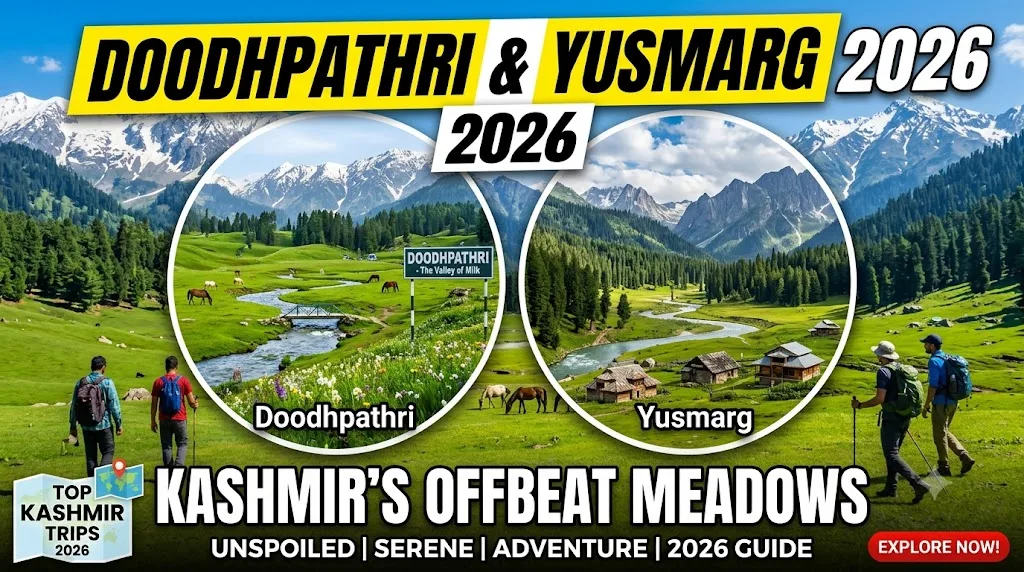
Ask most first-time visitors to name a Kashmir hill station and you’ll hear the same three answers — Gulmarg, Pahalgam, Sonmarg. Doodhpathri and Yusmarg rarely make that list, and that’s exactly their appeal. Both are wide alpine meadows in the Budgam district, both sit within a comfortable day-trip distance of Srinagar, and both still feel like Kashmir before the crowds arrived.
This guide covers everything you actually need before visiting either meadow — how to get there, what it costs, the best months to go, and the small details (no ATMs, weak network, no real eateries) that catch unprepared travelers off guard.
Doodhpathri: The Valley of Milk
How It Got Its Name
Doodhpathri means “valley of milk,” and the story behind it is rooted in Kashmiri Sufi tradition. Local legend credits the saint Sheikh-ul-Alam (also known as Nund Rishi) with striking the ground here in search of water, after which a milky-white stream is said to have flowed out instead. Today, the explanation is simpler but no less charming — the Shaliganga River runs swiftly over pale stones, churning into a frothy, milk-like white that gives the valley its name.
Location and Distance
Doodhpathri sits in the Khansahib tehsil of Budgam district, at an altitude of roughly 2,730 metres in the Pir Panjal range. It’s located about 40–45 km from Srinagar, and the drive typically takes 1.5 to 2 hours one way, depending on road conditions and the season.
Best Time to Visit Doodhpathri
| Season | Months | What to Expect |
|---|---|---|
| Spring | April–May | Melting snow, fresh greenery, wildflowers beginning to bloom |
| Summer | May–September | Lush meadows, pleasant temperatures (10–25°C), peak tourist season |
| Autumn | September–November | Golden meadows, clear skies, fewer crowds |
| Winter | December–February | Heavy snowfall, often inaccessible by road |
Most travelers find May to September the easiest window, since the road stays reliably open and the meadow is at its greenest.
Getting There
There’s no train or direct bus to Doodhpathri. The standard route is Srinagar → Budgam → Khan Sahib → Doodhpathri, and the road is mostly blacktopped except for a narrower, winding final stretch.
- Private taxi (round trip): Roughly ₹2,500–5,000 depending on vehicle type and season
- Budget option: A shared sumo from Srinagar’s Batmaloo area to Khan Sahib, followed by a local cab for the final stretch
- Self-drive: Feasible in summer; a 4×4 is preferable if attempting it in early spring or late autumn
What to Do There
- Riverside walks along the Shaliganga, especially near the footbridges where the “milky” current is most visible
- Meadow picnics, with local stalls nearby serving kahwa and basic snacks
- Pony rides to nearby viewpoints — agree on the price and route before mounting
- Short treks, including the gentle walk to Reshikhal meadow, about 4 km away
- Photography, particularly in the early morning when the meadow is still and the light is soft
Practical Details
There’s no formal entry fee for Doodhpathri, though a small parking or eco fee (commonly ₹50–100 per vehicle) may apply at the checkpoint. The valley itself has no proper market or hotel — pack your own lunch, since the only options are small tea and snack stalls run by local vendors. A JKTDC resort offers basic overnight stays if you’d rather not return to Srinagar the same day, though most visitors treat Doodhpathri as a single-day excursion.
Yusmarg: The Meadow of Jesus
How It Got Its Name
Yusmarg’s name has a more contested but widely repeated origin. Local Kashmiri tradition — tied to the Ahmadiyya community’s beliefs — holds that “Yus” refers to Jesus and “Marg” means meadow, giving “Yusmarg” the literal meaning of “Meadow of Jesus.” It’s a claim historically debated by scholars, but it adds a distinctive layer to the valley’s folklore.
Location and Distance
Yusmarg sits at around 2,390–2,400 metres in Budgam district, roughly 47–55 km from Srinagar via Charar-e-Sharief and Chadoora. The drive generally takes between 1.5 and 2.5 hours, depending on the season and traffic near Srinagar.
Best Time to Visit Yusmarg
| Season | Months | What to Expect |
|---|---|---|
| Spring | April–June | Wildflowers, melting snow on the ridgelines, pleasant days |
| Summer/Monsoon | June–August | Lush green meadows; occasional rain and landslide risk |
| Autumn | September–October | Golden meadows, clear skies, considered the most photogenic period |
| Winter | November–February | Heavy snowfall; good for snow activities but road access can be intermittent |
Late April through June, and again in September, are generally regarded as the most reliable windows for clear roads and good weather.
Getting There
There’s no regular public bus service to Yusmarg, so a private taxi is the most practical choice.
- Private taxi (full day, sedan): Approximately ₹2,000–2,600
- Recommended departure time: Leaving Srinagar by 7 AM gets you to Yusmarg by roughly 9–9:30 AM, leaving a full day for the meadow and Nilnag Lake before heading back
- En route stop: Charar-e-Sharief, about 20 km before Yusmarg, houses the shrine of Sheikh Noor-ud-din Noorani (Nund Rishi), one of Kashmir’s most revered Sufi saints — worth a respectful half-hour visit
What to Do There
- Trek to Nilnag Lake, roughly 4–6 km from the main meadow, reachable on foot (3–4 hours round trip) or by pony (around 2.5 hours round trip)
- Walk along the Doodh Ganga River, which winds through the meadow and gives the valley its second milky-white river
- Visit Sang-e-Safed (“White Rocks”) valley, about 10 km away — a longer trek best suited to those staying overnight or with proper trekking gear
- Birdwatching, with rare Himalayan species like the Western Tragopan reported in the surrounding forest, best attempted early morning
- Winter activities such as snowshoeing and pony rides through snow-covered meadows, if visiting between December and February
Practical Details
Entry to Yusmarg is free, and accommodation is limited to JKTDC tourist bungalows/hutments along with a handful of small private guesthouses — book ahead if visiting during peak summer weekends. There are no ATMs in or around Yusmarg, so carry enough cash (₹2,000–3,000 is generally sufficient for a day trip covering food and pony rides). Mobile connectivity is weak and patchy throughout the valley, so it’s worth downloading offline maps and informing someone of your itinerary before setting out.
Doodhpathri vs Yusmarg: Which One Should You Choose?
Both meadows offer a similar offbeat, uncrowded experience, but they suit slightly different kinds of travelers.
| Factor | Doodhpathri | Yusmarg |
|---|---|---|
| Distance from Srinagar | ~40–45 km | ~47–55 km |
| Drive time | 1.5–2 hours | 1.5–2.5 hours |
| Best for | Quick day trips, families | Trekkers, longer stays |
| Standout feature | The “milky” Shaliganga River | Nilnag Lake trek |
| Crowd level | Slightly quieter | Growing in popularity |
| Overnight stay | Possible (JKTDC resort) | Recommended for trekkers |
If you only have a few hours to spare, Doodhpathri’s shorter drive and easy riverside walks make it the more time-efficient choice. If you’re comfortable with a longer day or an overnight stay and want a proper trek to a lake, Yusmarg’s Nilnag trail is the better pick.
Travel Tips for Both Meadows
- Carry cash — neither destination has ATMs, and card payments are essentially unavailable
- Pack your own food — both valleys have only basic tea/snack stalls, with no real restaurants
- Dress in layers — even in summer, mornings at these altitudes can be cold, and the wind through the pine forests is sharp
- Check road status before heading out, especially outside the May–October window, since both routes can be affected by snow or landslides
- Negotiate pony and taxi rates upfront, and confirm the exact destination before starting, since vague agreements often lead to disputes later
- Respect local communities, particularly Gujjar and Bakarwal shepherd families who use these meadows for seasonal grazing — ask before photographing people
Key Takeaways
- Doodhpathri and Yusmarg are both quiet, offbeat alpine meadows in Budgam district, ideal alternatives to Kashmir’s busier hill stations
- Doodhpathri is closer to Srinagar and better suited to a quick, half-day or full-day trip
- Yusmarg rewards a longer visit, especially for travelers interested in the trek to Nilnag Lake
- Both destinations have limited food and accommodation options, so planning ahead matters
- May to September is generally the most reliable travel window for both, while winter access depends heavily on snowfall
Conclusion
Doodhpathri and Yusmarg won’t show up in glossy Kashmir brochures the way Gulmarg or Pahalgam do, and that’s precisely why they’re worth the detour. A few hours in either meadow — walking beside a milky river, watching ponies graze in open grassland, or simply sitting still in the quiet — gives a different, calmer sense of the valley than the more commercialized tourist circuits. Plan around the season, carry cash and warm layers, and you’ll find both meadows easy to add to almost any Kashmir itinerary.
Frequently Asked Questions
1. Can I visit both Doodhpathri and Yusmarg in a single day from Srinagar?
It’s technically possible but rushed, since both involve 1.5–2.5 hour drives in different directions from Srinagar. It’s more comfortable to dedicate a separate day to each.
2. Is there an entry fee for Doodhpathri or Yusmarg?
No formal entry fee applies to either destination, though a small parking or eco fee may be collected at Doodhpathri’s checkpoint.
3. Do I need a 4×4 vehicle to visit these meadows?
Not during summer, when regular sedans manage the roads fine. A 4×4 becomes useful or necessary in winter and early spring when snow affects the final stretch of road.
4. Is mobile network available at Doodhpathri or Yusmarg?
Coverage is weak and inconsistent at both locations, typically limited to BSNL and Airtel in patches near the main meadow areas. Don’t rely on it for anything urgent.
5. Are these destinations safe for solo travelers and families?
Yes, both are considered safe and family-friendly. That said, given the limited connectivity, it’s wise to inform someone of your itinerary and carry a basic first-aid kit.
Official Resources
- Jammu and Kashmir Tourism Development Corporation (JKTDC) — jktdc.co.in
- Jammu and Kashmir Government Official Portal — jk.gov.in
- Department of Tourism, Jammu and Kashmir — tourism.jk.gov.in

Rahul Naik is a Jammu & Kashmir local who has spent years exploring the Kashmir Valley, Jammu region, and high-altitude areas of the Union Territory. He has personally visited every major destination covered on VisitJK — from Dal Lake houseboats to Gulmarg slopes to the remote villages of the Gurez Valley. VisitJK is built on that firsthand experience — honest, practical travel content written for visitors who want real information, not brochure language.