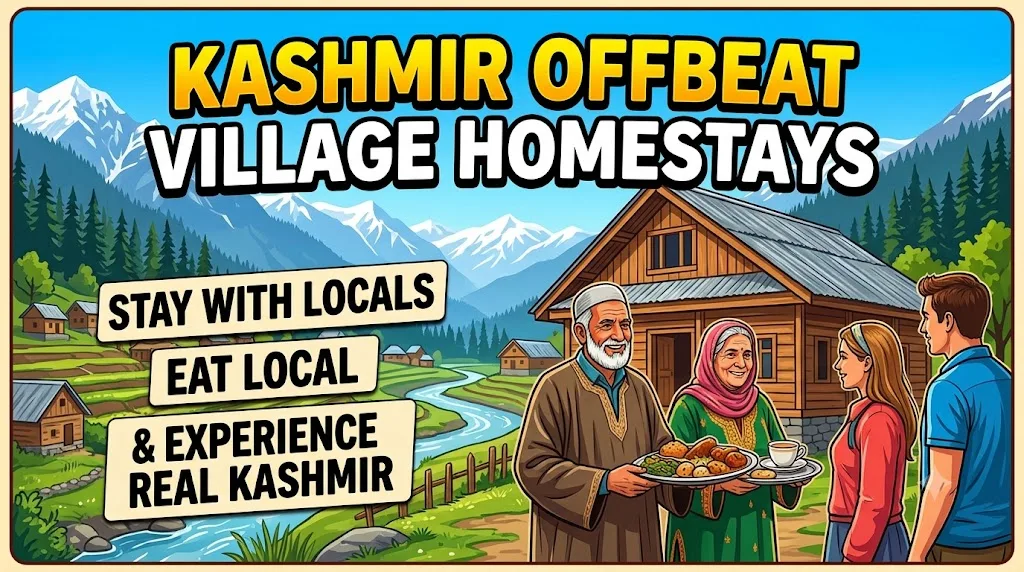
There is a version of Kashmir that most visitors never see. It exists about twenty kilometres past the last signboard for a popular tourist site, in villages where the morning begins with the smell of wood smoke and fresh-baked bread rather than hotel buffet trolleys, and where the mountains are visible from your window without a viewing deck or a fee.
Village homestays are how you reach that version of Kashmir.
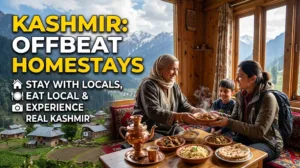
Jammu and Kashmir now has over 2,350 registered homestays offering more than 17,000 beds across the Union Territory, spread across mountain hamlets, orchard villages, riverside settlements, and high-altitude meadow communities. These are not boutique hotels that call themselves homestays. They are actual family homes — traditional wooden Kashmiri houses, walnut-beamed rooms, kitchens run by mothers and sisters — where the food comes from the same kitchen the family uses and the conversation happens on the floor, on hand-knotted carpets, the way it has always happened in Kashmir.
This guide covers the best offbeat regions for village homestays in 2026, what a genuine homestay experience involves, the food you’ll eat, what things cost, practical tips, and how to approach the experience in a way that genuinely benefits the communities that open their homes to you.
Why a Homestay, Not a Hotel
The question worth answering first is the obvious one — why stay in a village family’s home when hotels offer more predictable comfort?
The honest answer is that the two types of stay offer fundamentally different things, and which one you choose depends on what you actually want from Kashmir.
Hotels give you reliable hot water, a menu with several options, Wi-Fi that works, and a degree of anonymity. You experience Kashmir from a certain remove — looking at it through glass, visiting it during the day and retreating to standardised comfort in the evenings.
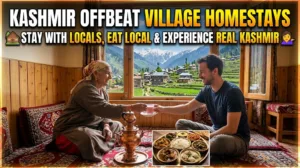
A village homestay inverts this entirely. You arrive not as a guest of a business but as a guest of a family. Your host’s mother probably cooked your dinner using vegetables from the kitchen garden behind the house. Your host knows every trail, every local story, every shortcut through the pine forest, and most of them are happy to share this knowledge with anyone who is genuinely curious.
There is also the matter of where your money goes. In a hotel, most of what you pay filters through ownership and management structures before any fraction reaches the local community. In a family-run homestay, your payment goes directly to the family — helping to send children to school, maintain an old wooden house, or expand a small farming operation. This is not an abstract benefit. It is the actual economic difference between a family that manages and a family that thrives.
What a Kashmiri Village Homestay Actually Looks Like
Before diving into specific destinations, it helps to understand what you are booking when you book a village homestay in Kashmir, because the reality is both simpler and richer than most travellers expect.
The House
Traditional Kashmiri village architecture is built in timber and brick, with intricately carved wooden facades, multi-storey layouts, and wide verandahs that catch the mountain light in the afternoon. The family typically occupies the upper floors and uses the ground floor for storage or cattle during winter. Guest rooms are clean, simply furnished with local wooden furniture, and heated in winter by a bukhari — a traditional metal wood-burning stove that becomes the social centre of the room once lit. Thick quilts and wool blankets are standard. Attached bathrooms vary from homestay to homestay; some are separate shared facilities, others are fully private.
Do not expect a minibar, a flat-screen television, or a rain shower. Do expect thick blankets, a window that frames a mountain, and the occasional village dog who will develop a proprietorial interest in your breakfast.
The Meals
This is where village homestays in Kashmir genuinely outperform almost every alternative. The food is cooked in the family kitchen from local produce, and it is exceptional.
A typical morning might begin with girda — the round Kashmiri bread baked fresh in a clay oven — alongside homemade butter, local honey, and noon chai, the distinctive pink salt tea that takes most visitors a cup or two to properly appreciate. Walnut halwa, soft and slightly sweet, appears on many breakfast tables in villages where the walnut trees grow right outside.
Lunch is often rice-based — cooked with local spices, served with a simple dal or a vegetable curry using whatever the kitchen garden currently offers. If the family keeps chickens or the village butcher is accessible, meat dishes appear at dinner. The Kashmiri flavour profile is distinctive — warm spice, dried fruits, and the occasional saffron note in richer dishes.
Dinner is the meal most likely to involve the whole family sitting together. In many homestays, particularly in more remote villages, the host makes a point of eating with guests — this is when the real conversation happens, when you learn about the village’s history, the family’s connection to the land, the changes in Kashmir over the past decade.
Best Regions for Offbeat Village Homestays
Gurez Valley — The Most Remote, Most Rewarding
The Dard-Shina community of Gurez Valley has been hosting travellers with genuine warmth since the valley opened more broadly to tourism. Homestays here are clustered around Dawar and the villages of Tulail — the same Tulail that most tourists never reach because Dawar already feels remote enough.
What makes a Gurez homestay distinctive is not just the extraordinary setting — the Kishanganga River, the pyramid of Habba Khatoon Peak, the meadows at altitude — but the cultural layer underneath it. The Dard-Shina people speak a language distinct from Kashmiri and have maintained architectural traditions, textile patterns, and a way of daily life that tourism has not yet significantly altered. Your hosts are likely to be farmers, fishermen, or small-scale herders who converted rooms in their homes to accommodate visitors. The meals are simple and filling, the nights are extraordinarily silent, and the sky at altitude carries more stars than most visitors have ever seen at once.
Families in Tulail’s Badwan village have been running homestays for years, some receiving between 100 and 200 visitors per season. The operation is genuinely family-run — sisters prepare meals, brothers serve as guides for local treks, and fathers share the oral history of the valley over evening tea.
Best season: May to October
Getting there: Private taxi from Srinagar via Bandipora and Razdan Pass; 6–7 hours
What to carry: Cash (no ATMs in Dawar), postpaid SIM, warm layers
Lolab Valley — The Land of Love and Beauty
Lolab Valley in Kupwara district, about 110–120 km from Srinagar, is the kind of place that makes you instinctively slow down the moment you arrive. The valley is divided into three sub-valleys — Potnai, Brunai, and Kalaroos — each with its own particular character: dense deodar and walnut forests, apple and cherry orchards, glacier-fed streams running through meadows wide enough to lose yourself in.
The name Lolab is believed to derive from a local chieftain who ruled here in ancient times. The local communities are known for hospitality that is warm without being performative — people here are genuinely pleased to see visitors in a valley that still sees relatively few.
Homestays are available in and around Kalaroos, Diver, and Chandigam — small settlements where the houses are old, the orchards are productive, and the pace of life is set by the seasons and the weather rather than by clocks. Meals are home-cooked using local produce: rice, vegetables, slow-braised meat when available, and the strong, sweet kahwa that arrives in rounds whether you ask for it or not.
The Kalaroos Caves, believed to contain ancient inscriptions, and the Nagmarg Meadow are both accessible from Lolab’s homestay villages, making it an easy base for gentle exploration without requiring long drives back to a hotel each evening.
Best season: April to October
Getting there: Srinagar → Baramulla/Sopore → Kupwara → Kalaroos/Sogam; approximately 3–4 hours
Permit requirement: No special permit for most of the valley; carry government-issued photo ID
Aru Valley — Pahalgam’s Quieter Neighbour
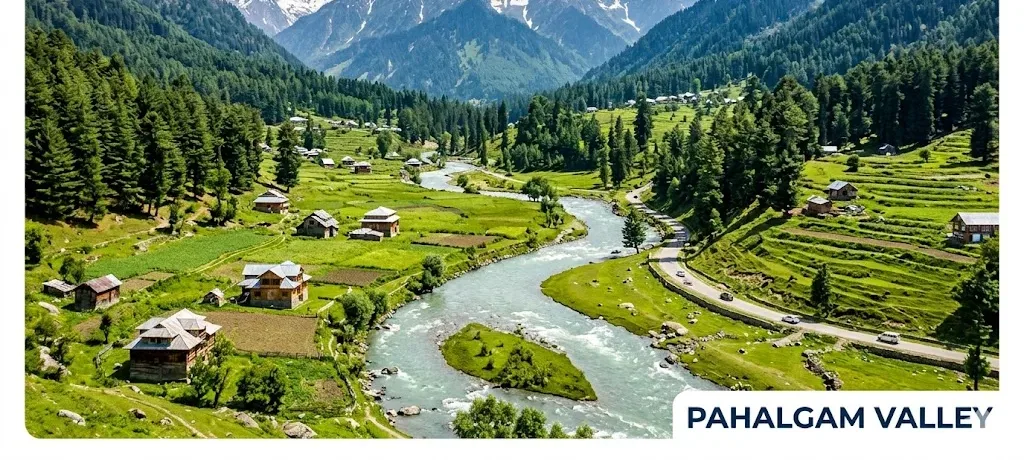
Fifteen kilometres beyond Pahalgam, where the tourist infrastructure of Kashmir’s most famous hill station gives way to older pine forest and the Lidder River narrows between its banks, Aru Valley opens into a wide, grassy bowl surrounded by cedars. It serves as the base camp for two of Kashmir’s best-known high-altitude treks — the Tarsar Marsar route and the Kolahoi Glacier trail — but for non-trekkers, Aru is simply one of the most peaceful meadow settlements in the valley.
The homestays here sit right at the edge of the main village, which is small enough that you know its geography within the first hour. Rooms typically have mountain views — the kind that take a moment to process when you first open the curtains in the morning. Hosts tend to be knowledgeable about local trails and will point you toward routes that don’t appear on any map or app.
The food reflects Pahalgam’s slightly higher-altitude produce: river trout appears frequently given the nearby Lidder, and the bread is baked fresh each morning. Evenings in Aru are quiet enough that you can hear the river from bed.
Best season: May to September
Getting there: Srinagar → Pahalgam (95 km), then local cab to Aru (15 km)
Note: Aru is more developed than Gurez or Lolab; book ahead in July and August
Bangus Valley (Bungus) — Kashmir’s Least-Visited Meadow
Bangus Valley — spelled variously as Bungus — sits in Kupwara district at approximately 10,000 feet above sea level, covering 300 square kilometres of alpine meadow, coniferous forest, and snow-fed streams. It is divided into Bada Bungus and Chota Bungus, each a wide grassland bowl that sits quietly at an altitude where the air has a particular quality — clean and slightly thin — and the silence is structural rather than incidental.
Accommodation inside the valley is deliberately limited, which is precisely what protects it. The primary option for those who want a genuinely local experience is a stay in the villages around the valley’s perimeter — Reshwari and Tangdar both have family homestays where Kashmiri meals are included. The Gujjar communities who use the upper meadows seasonally for livestock grazing are among the most genuinely welcoming people in North Kashmir, and their hospitality toward travellers who approach respectfully is real and uncomplicated.
This is a destination for people comfortable with basic facilities, limited connectivity, and the particular pleasure of being somewhere that most visitors to Kashmir never reach. The night sky above Bungus is exceptional.
Best season: June to September (snow closes access before and after)
Getting there: Srinagar → Kupwara → Handwara → valley approach; approximately 4–5 hours
Note: Carry all supplies including food backup; village options are limited
Pahalgam’s Village Fringe — Maamal Shikargah and Beyond
Beyond Pahalgam’s main tourist circuit, in villages like Maamal Shikargah and Dahwatoo, a quieter tradition of hosting travellers has been running for years. These are family operations started by people with backgrounds in guiding and tourism who decided they wanted visitors to experience Kashmir from inside a home rather than inside a resort.
One of the distinctive things about homestays in this area, reported by hosts themselves, is the deliberate choice to sit with guests — on floor carpets, in the traditional Kashmiri way — rather than maintain the distance of a hotel transaction. “It is not a typical guest-and-owner relationship,” one longtime host explained. “We sit together as we traditionally do in Kashmir.” This is not a marketing posture. It is the genuine social structure of Kashmiri domestic hospitality, which has always been built around offering the best of what you have to whoever comes through the door.
Best season: April to October
Getting there: Srinagar → Pahalgam (95 km); village homestays accessible by local cab
Kashmiri Food You Will Eat at a Village Homestay
One of the most consistent pleasures of a village homestay stay is the food, which differs meaningfully from what most restaurants serve.
| Dish | What It Is | When Served |
|---|---|---|
| Girda | Round, fresh-baked Kashmiri bread from a clay oven | Breakfast |
| Noon Chai | Pink salt tea, mildly savory, warming | Morning and evening |
| Kahwa | Green tea with saffron, cardamom, almonds | Throughout the day |
| Haakh | Kashmiri collard greens cooked in mustard oil | Lunch or dinner |
| Rogan Josh | Slow-braised lamb in a Kashmiri spice base | Special occasion dinner |
| Dum Aloo | Baby potatoes cooked in yoghurt and spice | Common side dish |
| Walnut Halwa | Crushed walnut sweetened dessert | Breakfast or evening |
| Modur Pulao | Sweet rice with dry fruits and saffron | Festive meals |
| Trout (Maach) | Fresh river trout, grilled or pan-cooked | Near river villages |
The defining quality of homestay food is that it is seasonal and local. What appears on the table reflects what is growing, what was preserved from the previous season, and what the family eats themselves. This is the opposite of restaurant food, where the menu is fixed regardless of season or locality.
What Things Cost
Village homestays in Kashmir are significantly more affordable than hotel stays in the same areas, and the value-to-experience ratio is arguably higher.
| Region | Approximate Cost per Night (Including Meals) |
|---|---|
| Gurez Valley (Dawar / Tulail) | ₹800 – ₹1,500 per person |
| Lolab Valley (Kalaroos / Chandigam) | ₹700 – ₹1,200 per person |
| Aru Valley | ₹1,000 – ₹2,000 per person |
| Bangus Valley (perimeter villages) | ₹700 – ₹1,200 per person |
| Pahalgam village fringe | ₹1,000 – ₹2,500 per person |
Meals are almost always included in homestay rates — breakfast and dinner typically, with lunch negotiable. Always confirm the meal inclusion and cost clearly before finalising a booking.
How to Find and Book a Village Homestay
This is the part that confuses most travellers, because village homestays in Kashmir are not uniformly listed on booking platforms. The discovery process is more organic.
Option 1 — J&K Tourism Department: The Department of Tourism, J&K, maintains a list of registered homestays across the UT. Registered homestays have been inspected and meet minimum facility standards. Starting with this list gives you vetted options.
Option 2 — Google Maps: Many village homestays in Gurez, Lolab, and Aru are now listed on Google Maps by their operators. Searching “homestay Dawar Gurez” or “homestay Kalaroos Lolab” surfaces real current options with direct contact numbers.
Option 3 — Local taxi drivers and guides in Srinagar: This is the most underused and often most reliable option. A driver who regularly runs routes to Gurez or Lolab knows the families running homestays in those areas, has current information about which ones are operating, and can often make an introduction directly.
Option 4 — Online travel communities: Kashmir-specific Facebook groups and travel communities often have recent firsthand recommendations for specific homestays, including contact numbers and current pricing.
Always call ahead. Unlike hotels with online availability systems, most village homestays operate on direct communication. Arriving without prior arrangement in peak season — particularly July and August — risks finding no vacancy in small villages.
Responsible Homestay Travel: A Short Guide
Village homestay tourism benefits communities most when travellers approach it thoughtfully.
- Pay the agreed rate without bargaining. Unlike souvenirs in a market, homestay rates are set at a level the family needs to make the arrangement worthwhile. Bargaining for accommodation directly reduces income for people who are already offering significant value.
- Ask before photographing people. Kashmiri village communities are not tourist attractions. Ask permission before taking photographs, especially of women, elderly family members, and children.
- Minimise waste. Remote villages often have no waste management infrastructure. Carry your packaging out and do not leave non-biodegradable waste behind.
- Respect the household routine. Homestays run on family schedules. Meal times, quiet hours, and household rhythms deserve respect rather than adjustment to your preferences.
- Learn a few words. Even a handful of Kashmiri phrases — Salam (hello), Shukria (thank you), Kyah chhu naam (what is your name) — signals respect and opens conversations that otherwise wouldn’t happen.
Best Season for Offbeat Village Homestays
| Season | Months | Experience |
|---|---|---|
| Spring | April–May | Apple blossoms, meadows turning green, very few visitors, cool temperatures |
| Summer | June–August | Peak season, warmest weather, all routes open, highest visitor numbers |
| Autumn | September–October | Golden orchards, clearest skies, best photography, noticeably fewer crowds |
| Winter | November–March | Most remote homestays closed; some Pahalgam-area stays open with snow experiences |
Autumn — September specifically — is the season most recommended by experienced Kashmir travellers for village homestay visits. The apple harvest is underway, the light is extraordinary, the crowds of July have receded, and the valley has a golden, unhurried quality that spring and summer simply don’t offer.
Key Takeaways
- Jammu and Kashmir now has over 2,350 registered homestays, spread across valleys, hamlets, and mountain communities far beyond the main tourist circuit
- Village homestays offer direct cultural immersion through family meals, local conversation, and daily life that hotels cannot replicate
- The best offbeat regions for authentic homestay experiences are Gurez Valley, Lolab Valley, Aru Valley, Bangus Valley, and the village fringe around Pahalgam
- Costs run from approximately ₹700 to ₹2,500 per person per night including meals — significantly less than most hotel stays
- September is the finest month for a village homestay experience — golden orchards, clear skies, and far fewer visitors than peak summer
- Always book ahead by phone or through local contacts; most genuine village homestays are not consistently available on mainstream booking platforms
- Responsible travel — paying fair rates, asking before photographing, minimising waste — ensures that homestay tourism genuinely benefits the communities that make it possible
Conclusion
Kashmir’s village homestays are not a budget alternative to proper accommodation. They are a different kind of travel experience entirely — one that asks more of you, gives you more in return, and leaves you with a relationship to the valley that photographs of Dal Lake and houseboat sunsets cannot provide.
The families who open their homes to travellers are doing something generous. They are inviting strangers into their daily lives, feeding them from their kitchens, sharing the view from their windows, and trusting that the exchange will be worthwhile. The travellers who approach this with genuine curiosity rather than consumer expectation tend to leave Kashmir with something that goes beyond holiday memories.
The real Kashmir — the one that moves slowly through the seasons, that smells of walnut smoke and fresh bread, that tells its own stories on its own terms — is found in these villages. It has always been there. It is simply a matter of showing up.
Frequently Asked Questions
1. Are village homestays in Kashmir safe for solo female travellers?
Yes, registered family homestays in Kashmir are generally considered safe for solo female travellers. Kashmiri households observe conservative social norms, which in practice means guests are treated with strong protective hospitality. The usual precautions — sharing your itinerary with someone, choosing registered homestays, and maintaining direct contact with your host — apply as they would anywhere.
2. Do I need to book a village homestay far in advance?
For peak season visits in July and August, booking two to four weeks in advance is strongly advisable, particularly for popular locations like Aru Valley and Gurez. For the shoulder seasons — May, June, September, and October — one to two weeks ahead is usually sufficient. Off-season visits in spring can sometimes be arranged a few days before arrival.
3. What should I pack for a village homestay stay?
Beyond standard travel essentials, bring: warm layers regardless of season since village evenings at altitude cool quickly; cash as ATMs are unavailable in most remote village areas; a postpaid SIM since prepaid cards do not work in J&K; a basic first-aid kit since the nearest pharmacy may be far; and a reusable water bottle with a filter for remote areas.
4. Can families with children stay comfortably in village homestays?
Yes, Kashmiri families are particularly welcoming of children and family groups. Children often become natural icebreakers — they’re welcomed into games, kitchens, and farm routines in ways that adult travellers sometimes have to work harder to reach. Basic child-safe facilities (warm blankets, clean water, simple food) are available at most registered homestays.
5. Is there a formal registration or quality standard for Kashmir homestays?
Yes. The J&K Department of Tourism registers and periodically inspects homestays across the UT as part of a broader push toward responsible rural tourism. Registered homestays meet minimum facility standards for rooms, sanitation, and safety. Choosing a registered homestay over an unregistered one gives you a baseline assurance of quality and ensures your stay contributes to the formal rural tourism economy.
Official Resources
- Jammu and Kashmir Tourism Department — tourism.jk.gov.in
- Jammu and Kashmir Tourism Development Corporation — jktdc.co.in
- Jammu and Kashmir Government Official Portal — jk.gov.in
- Ministry of Tourism, Government of India (Homestay Guidelines) — tourism.gov.in

Rahul Naik is a Jammu & Kashmir local who has spent years exploring the Kashmir Valley, Jammu region, and high-altitude areas of the Union Territory. He has personally visited every major destination covered on VisitJK — from Dal Lake houseboats to Gulmarg slopes to the remote villages of the Gurez Valley. VisitJK is built on that firsthand experience — honest, practical travel content written for visitors who want real information, not brochure language.