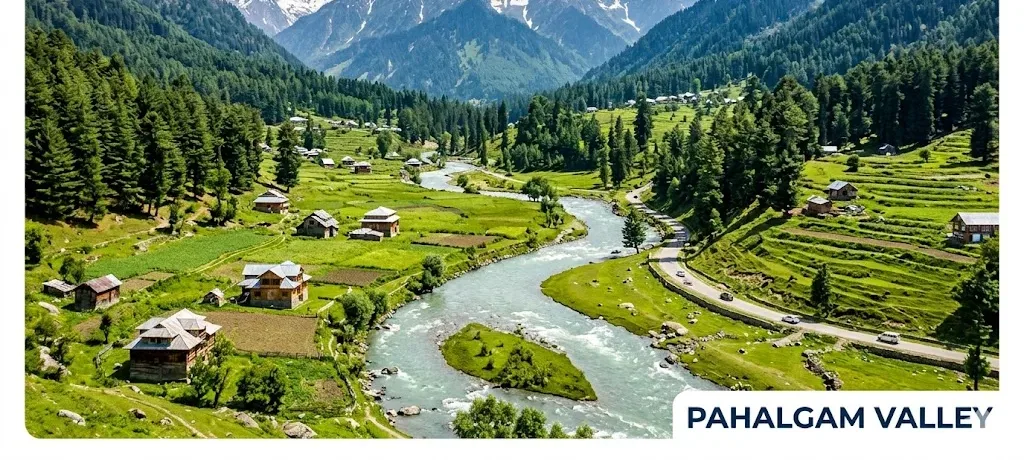
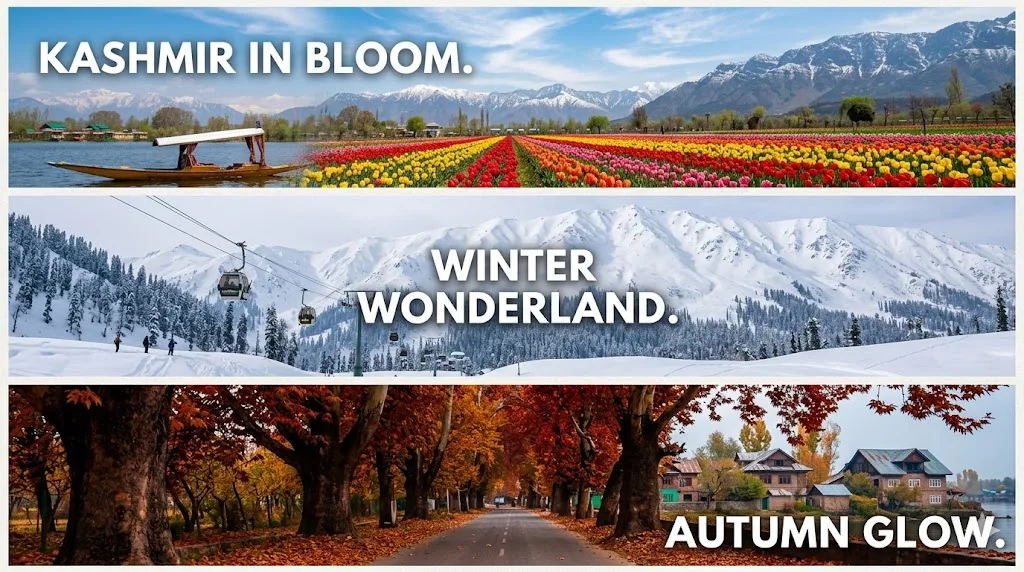
The most common question about Kashmir is also the most important one to get right: when should I go? The honest answer is that Kashmir is worth visiting in every season — but each season offers a completely different experience, and the wrong timing for your specific interests can mean missing what makes Kashmir special.
This guide breaks down every month of the year — what the weather is actually like, what is open, what is crowded, what costs more, and who each window suits best.
The Short Answer — By Travel Type
Before the month-by-month detail, here is the quick reference:
| What You Want | Best Time |
|---|---|
| Tulip Garden in bloom | Late March – mid April |
| Pleasant weather, everything open | April – June |
| Greenest meadows, budget travel | July – August |
| Autumn colours, fewer crowds | September – October |
| Snow, skiing at Gulmarg | December – February |
| Saffron fields in bloom (Pampore) | Mid October – early November |
| Honeymoon / romantic trip | April–May or September–October |
| Family trip with children | May – June |
| Adventure and trekking | June – September |
| Budget travel, off-peak | November or March |
Season by Season
Spring — March to May
Spring is when Kashmir announces itself after winter. Snow melts from the lower elevations, the chinar trees burst into bright green, and the valley transforms from white and bare to vivid and alive within a matter of weeks.
March is the transition month. Early March can still be cold with occasional snowfall at valley level. By late March, the almond trees bloom first — the orchards around Budgam and Chadoora turn white and pink. The famous Tulip Garden in Srinagar (Asia’s largest tulip garden, on the slopes of Zabarwan mountain overlooking Dal Lake) opens in late March and typically peaks in early to mid April. The garden has over 1.5 million tulips in dozens of varieties — it is genuinely spectacular during peak bloom, usually a window of about 10–15 days.
April is one of the best months to visit overall. The Tulip Garden is in full bloom in early April. Temperatures in Srinagar are comfortable — 15°C to 20°C during the day. Gulmarg still has snow and the gondola is running. Pahalgam is fully accessible. Hotels are not yet at peak season prices. This is the sweet spot for travellers who want pleasant weather, the tulips, and some snow still in the higher reaches — without paying summer peak rates.
May is when peak season begins in earnest. Schools in the rest of India are closing for summer and family groups start arriving in large numbers. The weather is warm and comfortable — Srinagar reaches around 25–28°C at its peak. The meadows at Gulmarg are fully green, the gondola runs all day, and every hotel and houseboat on Dal Lake fills up. Book accommodation at least 4–6 weeks in advance for May travel.
Temperature range (Srinagar): 10°C – 28°C across March–May
Summer — June to August
Summer is Kashmir’s peak tourist season — and also its most divisive. If you ask locals, many will tell you September or October is better. If you ask tour operators, they will tell you June–August. Both are right for different reasons.
June is peak season at its height. Every major destination is fully open — Sonamarg, Pahalgam, Gulmarg, all the trek routes. The weather is warm but not uncomfortable — Srinagar averages 28–30°C, which feels pleasant compared to the 40°C+ that visitors are often escaping from in Delhi or Rajasthan. The Amarnath Yatra pilgrimage begins in late June or early July, which significantly increases traffic on the Pahalgam route.
July and August are when Kashmir receives its light monsoon. Unlike the rest of India where monsoon brings heavy rainfall, Kashmir’s monsoon is mild — sporadic rain that keeps everything intensely green without disrupting travel significantly. The meadows at Gulmarg, Pahalgam, and Sonamarg are at their most vivid green. Waterfalls appear across the hillsides that are dry the rest of the year.
These months are actually good for budget travellers — hotel prices are slightly lower than May–June despite the weather being equally good, because many tourists incorrectly assume monsoon means heavy rain. You can find better deals in July–August than in June for equivalent accommodation.
Crowds: Summer is crowded. Dal Lake in June is busy from morning to evening. Gulmarg gondola queues can be long on weekends. Betaab Valley near Pahalgam is packed by 10 AM on any day. If you dislike crowds, summer is not your season — consider September instead.
Temperature range (Srinagar): 22°C – 32°C across June–August
Autumn — September to November
Autumn is Kashmir’s most beautiful season — and the most underappreciated by visitors from outside. September and October bring something that no other season offers: the chinar trees.
The chinar (Platanus orientalis) is Kashmir’s iconic tree — large, ancient, with broad leaves that turn from deep green to gold, orange, and deep red between October and November. Srinagar’s Mughal gardens, the Dal Lake embankments, and the villages of the valley are full of these trees. When they turn in October, the landscape becomes extraordinary — a palette of warm colours against the backdrop of the first snow appearing on the mountain peaks above the valley.
September is warm by day (around 22–25°C in Srinagar) and cool by night. The crowds from the summer peak have thinned. The meadows are still green. Trekking routes are at their best — dry, fully accessible, with clear skies. This is the favourite month for many experienced Kashmir travellers.
October is when the chinar colour peaks. Temperatures drop — Srinagar reaches 15–18°C by day and 5–8°C at night. Bring warm layers for evenings. The Mughal gardens and Dal Lake embankments are particularly beautiful. The saffron fields around Pampore (25 kilometres from Srinagar) bloom in mid to late October — a brief window of about 2–3 weeks when the purple flowers appear across the fields at dawn. If your timing allows, visiting Pampore during the saffron harvest is a unique experience found nowhere else in India.
November is transitional. Early November still has beautiful colour. By late November, the leaves have fallen, temperatures drop significantly, and some higher-altitude routes begin to close. This is a genuine off-peak month — fewer tourists, lower prices, and a particular quiet beauty to the valley as it prepares for winter. Not for everyone, but travellers who enjoy having famous places to themselves will find late November rewarding.
Temperature range (Srinagar): 5°C – 25°C across September–November
Winter — December to February
Winter in Kashmir is for a specific type of traveller. If you come for snow — specifically for skiing at Gulmarg or for the experience of a snow-covered Kashmir Valley — winter delivers something genuinely spectacular. If you come expecting the same experience as summer or autumn, you will find many things closed and conditions challenging.
December marks the beginning of the cold season. Gulmarg receives its first significant snowfall of winter. Srinagar gets occasional snow. The famous Chillai-Kalan — the harshest 40-day winter period in Kashmir — begins on December 21 and runs until January 31. During this period, temperatures in Srinagar can drop to -5°C or lower at night, and Gulmarg regularly reaches -15°C to -20°C.
January is the coldest month. Dal Lake partially freezes in cold winters — a dramatic sight. Gulmarg is at its best for skiing — consistent snow cover, operating ski lifts, and the valley largely to yourself outside of ski groups. The Z-Morh tunnel keeps Sonamarg accessible through winter in recent years, which was not previously possible.
February is still cold but begins to ease slightly toward the end of the month. Snowfall is still regular in Gulmarg. The valley is quiet — this is the lowest tourist traffic month of the year.
Who winter is for: Skiers and snowboarders who specifically want Gulmarg. Photographers who want the unique imagery of a snow-covered Kashmir. Travellers who want to experience Kashmir without any crowds. Those who want the atmospheric experience of Srinagar under snow — the houseboats, the Mughal gardens, the old city — all in winter conditions.
Who should avoid winter: Travellers with young children or elderly companions. Anyone without proper cold-weather clothing and footwear. Those who want to visit Pahalgam, Sonamarg (accessible but limited), or do trekking.
Temperature range (Srinagar): -5°C – 8°C across December–February
Month-by-Month Quick Reference
| Month | Temp (Srinagar) | Crowds | Cost | Highlight |
|---|---|---|---|---|
| January | -5°C to 5°C | Low | Low | Skiing, snow |
| February | -3°C to 8°C | Low | Low | Skiing, quiet valley |
| March | 5°C to 15°C | Low–Medium | Medium | Almond blossom, tulips begin |
| April | 10°C to 20°C | Medium | Medium | Tulip Garden peak |
| May | 15°C to 28°C | High | High | Perfect weather, everything open |
| June | 20°C to 30°C | Very High | High | Peak season, all routes open |
| July | 22°C to 32°C | High | Medium | Green meadows, light rain |
| August | 22°C to 30°C | High | Medium | Lush greenery, Amarnath Yatra |
| September | 15°C to 25°C | Medium | Medium | Best trekking, quieter |
| October | 8°C to 18°C | Medium | Medium | Chinar colours, saffron |
| November | 2°C to 12°C | Low | Low | Off-peak, late autumn |
| December | -2°C to 8°C | Low–Medium | Low–Medium | First snow, Gulmarg ski opens |
Practical Advice for Timing Your Trip
Book accommodation early for peak periods. Dal Lake houseboats, popular Gulmarg hotels, and Pahalgam resorts fill up 4–8 weeks in advance for April–June and September–October. Do not assume you can book on arrival during these windows.
Gulmarg gondola tickets sell out. In peak season, online advance booking is essential — particularly for Phase 2 (Apharwat Peak). Same-day queues can mean a 3–4 hour wait or no ticket at all.
Weather is unpredictable at altitude. Even in summer, evenings at Gulmarg (2,650m) and Sonamarg (2,740m) are cold. A warm layer is always needed. In the shoulder months (March, October), temperatures can drop quickly and unexpectedly.
The Amarnath Yatra (July–August) significantly increases traffic on roads between Srinagar and Pahalgam and between Srinagar and Baltal (the other base camp). If you are not participating in the Yatra, plan your Pahalgam trip either before late June or after mid-August to avoid the congestion.
Kashmir in 2026 is seeing record tourism numbers. Early booking — especially for popular periods — is more important this year than previous years.
The Honest Bottom Line
First-time visitor who wants the full Kashmir experience: April–May or September–October. These windows have the best weather, the most beautiful landscapes, and are not as chaotic as June–August.
Skiing and snow: December–February, specifically for Gulmarg.
Budget travel: July–August or November–March. You get the same Kashmir with lower prices and fewer crowds.
Photography: October for chinar colours. April for tulips and snow-capped mountains together. January for frozen lake and snow.
There is genuinely no bad time to visit Kashmir — only different Kashmirs, each worth experiencing on its own terms.
Published by VisitJK — honest travel guides for Jammu & Kashmir. Last updated May 2026.

Rahul Naik is a Jammu & Kashmir local who has spent years exploring the Kashmir Valley, Jammu region, and high-altitude areas of the Union Territory. He has personally visited every major destination covered on VisitJK — from Dal Lake houseboats to Gulmarg slopes to the remote villages of the Gurez Valley. VisitJK is built on that firsthand experience — honest, practical travel content written for visitors who want real information, not brochure language.