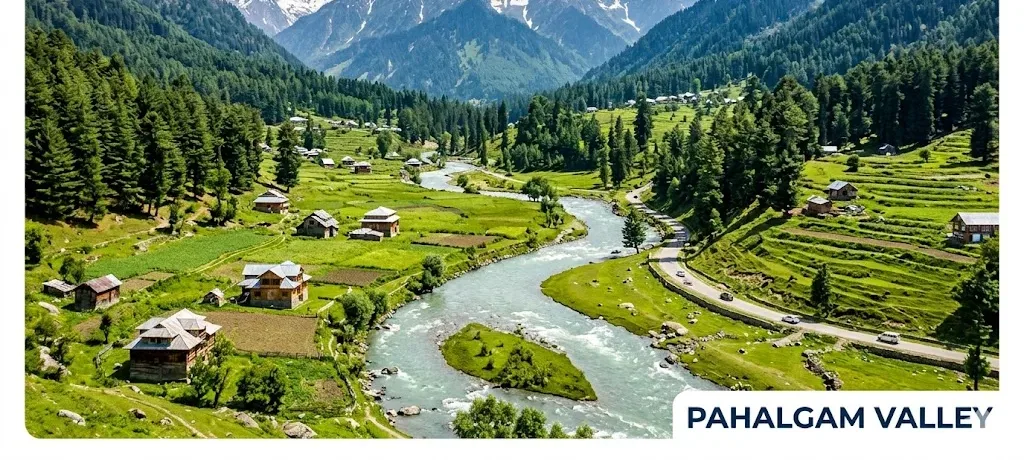

Pahalgam is Kashmir’s most complete destination. Where Gulmarg is defined by a single experience — the gondola — and Sonamarg by a single landscape — the high-altitude meadow — Pahalgam offers multiple distinct valleys, a river that runs through the town, forests, treks for every level, adventure activities, and an atmosphere that rewards staying longer rather than rushing through.
It is also, consistently, the destination that visitors to Kashmir say they wish they had spent more time in.
Where Is Pahalgam
Pahalgam is located in the Anantnag district of Jammu & Kashmir, approximately 95 kilometres from Srinagar. The town sits at an altitude of around 2,130 metres (6,990 feet) at the confluence of the Lidder River and the Sheshnag stream. The surrounding landscape — dense pine and fir forests, open meadows, and the fast-flowing Lidder — gives Pahalgam a character distinct from other Kashmir destinations.
The name Pahalgam means “Village of Shepherds” in Kashmiri — a reference to the Bakarwal and Gujjar communities who have traditionally used the high-altitude pastures around the town for seasonal grazing.
How to Reach Pahalgam
From Srinagar: The drive from Srinagar to Pahalgam takes approximately 2 to 2.5 hours covering 95 kilometres via the National Highway. The road follows the Jhelum River for much of the route, passing through the towns of Awantipora and Bijbehara. Near Awantipora, the ruins of two ancient Hindu temples from the 9th century AD are visible from the road — worth a brief stop if time allows.
Private taxis from Srinagar cost approximately ₹1,800–₹2,500 one way. Shared sumos from Batmaloo bus stand in Srinagar to Pahalgam cost ₹150–₹200 per seat and take 3–4 hours with stops.
By air: Nearest airport is Srinagar International Airport (SXR), approximately 95 kilometres away. Hire a private taxi from the airport.
By train: No direct train service. Nearest major railhead is Jammu Tawi, approximately 250 kilometres away. From Jammu, travel by road or bus to Srinagar and then to Pahalgam.
What to See Around Pahalgam
Betaab Valley
Located 15 kilometres from Pahalgam town on the road toward Chandanwari, Betaab Valley is a wide, flat meadow enclosed by forested mountains with the Lidder River running along its edge. The name comes from the 1983 Bollywood film “Betaab” which was shot here.
The valley is genuinely beautiful — the combination of the flat green meadow, dense forest walls on both sides, the river in the foreground, and snow-capped peaks visible above the treeline makes it one of the most photographed landscapes in Kashmir. It is best visited early morning before the day trippers arrive from Srinagar — by 10 AM it fills with visitors and the atmosphere changes.
Entry fee: ₹30–₹50 per person (subject to change). Vehicles pay a separate parking fee. Photography is free.
Aru Valley
12 kilometres from Pahalgam in a different direction from Betaab — Aru Valley requires a separate trip, not a continuation of the Betaab route. The valley is wider and more open than Betaab, with grasslands that stretch toward the treeline and a small village at its base.
Aru is the starting point for several major treks including the Kashmir Great Lakes Trek — considered one of the finest multi-day treks in India. It is also significantly quieter than Betaab, with fewer day-trip visitors and a calmer atmosphere.
Allow 3–4 hours for a proper Aru Valley visit — enough time to walk into the valley, sit for a while, and return without rushing.
Chandanwari
28 kilometres from Pahalgam, Chandanwari is the starting point of the Amarnath Yatra — the annual pilgrimage to the Amarnath Cave shrine that takes place every summer (June–August). Outside pilgrimage season, Chandanwari is accessible as a snow-activity destination — snow remains here until June or July when other areas have already melted.
The drive from Pahalgam to Chandanwari takes about 45 minutes on a narrow mountain road. The landscape becomes progressively more dramatic as you approach — open rocky terrain and the source of the Lidder River visible in the distance.
Baisaran
A meadow approximately 3 kilometres from Pahalgam town, accessible only by foot or horseback — no vehicles can reach it. The climb takes about 45 minutes to 1 hour on foot (or 20–25 minutes by horse). From Baisaran, looking back toward Pahalgam and the valley below, the views are among the best in the area.
Baisaran is also called “Mini Switzerland” by local guides and tourism marketing — a label that undersells it. The meadow and its surrounding pine forest do not need comparison to anything. It is worth visiting early morning or late afternoon when the light is best.
Sheshnag Lake
A high-altitude glacial lake approximately 23 kilometres from Pahalgam, accessible either by the Amarnath Yatra trek route or by a separate trek from Aru Valley. The lake sits at around 3,590 metres and is one of the most beautiful high-altitude lakes in Kashmir — deep blue, still, surrounded by glaciers and peaks.
This is a full-day trek (12–14 hours return from Pahalgam) and should only be attempted with a local guide and proper trekking equipment. Not suitable for casual visitors.
Adventure Activities in Pahalgam
River Rafting — Lidder River: White-water rafting on the Lidder River is available from April to June when water levels from snowmelt are highest. The rafting stretch runs from the upper reaches of the Lidder down through Pahalgam town and offers Class 2–3 rapids — suitable for beginners and families. Several operators in Pahalgam town offer 2–3 hour rafting packages.
Cost: approximately ₹600–₹1,000 per person for a standard session. Life jackets and helmets are provided. Confirm that the operator provides certified safety equipment before booking.
Trekking: Pahalgam is the base for some of Kashmir’s most celebrated treks:
- Kashmir Great Lakes Trek (7 days): One of India’s finest multi-day treks, covering 7 high-altitude lakes above 4,000 metres. Starts from Aru Valley. Requires a guide, camping equipment, and reasonable fitness.
- Kolahoi Glacier Trek (3–4 days): Trek to the Kolahoi Glacier, Kashmir Valley’s largest glacier. Moderate difficulty. Starts from Aru Valley.
- Tarsar Marsar Lake Trek (4–5 days): Two beautiful high-altitude lakes accessible from Aru Valley. Increasingly popular alternative to the Great Lakes trek.
- Sheshnag Lake Day Trek: Ambitious day trek covering significant altitude gain. Requires early start.
Trout Fishing: The Lidder River supports a healthy trout population. Fishing permits are available from the J&K Fisheries Department. This is a peaceful activity for visitors who want something completely different from the standard sightseeing circuit.
Horse Riding: Horse riding is widely available across all major sites around Pahalgam — to Betaab Valley, Baisaran, and along the Lidder River. Rates are negotiable. Agree clearly on destination, duration, and price before starting.
Where to Eat in Pahalgam
Pahalgam has restaurants ranging from basic local dhabas to mid-range hotel restaurants. The standard of food in the better restaurants is good — Kashmiri dishes, North Indian food, and simple Chinese-Indian are the main offerings.
Wazwan and Kashmiri food: Several restaurants along the main market serve Kashmiri dishes — Rogan Josh, Dum Aloo, Yakhni. Quality varies. The better places are slightly off the main tourist strip.
Local dhabas: The riverside area along the Lidder has several simple dhabas serving dal, roti, and rice at budget prices. These are the places to eat if you want to spend less.
Trout: Freshwater trout from the Lidder is available at some restaurants in Pahalgam. If you see it on a menu and the restaurant looks reputable, it is worth ordering — freshwater trout prepared Kashmiri style is excellent.
Where to Stay in Pahalgam
Pahalgam has a wide range of accommodation — from basic guesthouses to mid-range hotels to a few upscale properties. Most hotels are in or around the main town, with some properties located along the river.
Budget (₹800–₹2,000 per night): Several guesthouses in the main market area. Basic but functional. Look for rooms with windows facing the Lidder River for the best experience.
Mid-range (₹2,500–₹6,000 per night): Multiple hotels offer comfortable rooms with attached bathrooms, hot water, and some amenities. Book 3–4 weeks in advance for peak season.
Upscale (₹7,000 and above): A small number of resorts and heritage properties offer premium accommodation. The Welcomhotel Pine N Peak is the most established upscale option, set in pine forest above the town.
Staying overnight vs. day trip: Most visitors from Srinagar do Pahalgam as a day trip. This is a mistake. The drive takes 2.5 hours each way — that is 5 hours of your day in a vehicle. Staying overnight in Pahalgam gives you early morning access to Betaab Valley and Baisaran before crowds arrive, time to sit by the Lidder without rushing, and the evening atmosphere of the town after day-trippers leave. Pahalgam rewards an overnight stay far more than a hurried day visit.
Practical Tips
Carry cash: ATMs in Pahalgam can run out during peak season. Withdraw sufficient cash in Srinagar before travelling.
Amarnath Yatra period (June–August): The Yatra significantly increases traffic on the Srinagar–Pahalgam road and in Pahalgam town itself. If you are not participating in the Yatra, plan your visit either before late June or after mid-August to avoid severe congestion.
Betaab Valley early morning: Arrive at Betaab before 8:30 AM for the best experience. After 10 AM the valley fills with day-trippers and the peaceful quality is gone.
Weather: Pahalgam evenings are cool even in summer — temperatures can drop to 10–12°C after sunset. Carry warm layers regardless of the season.
Permits: No special permits required for Pahalgam or the main surrounding valleys for Indian citizens. The Amarnath Yatra has its own permit system managed by the Shri Amarnathji Shrine Board.
Best Time to Visit Pahalgam
| Season | Temperature | Highlights |
|---|---|---|
| April–May | 10°C – 22°C | Flowers, Lidder rafting, spring green |
| June–July | 15°C – 25°C | Lush greenery, all valleys accessible |
| August | 14°C – 24°C | Green meadows, lighter Yatra crowds |
| September | 10°C – 20°C | Best trekking season, autumn beginning |
| October | 5°C – 15°C | Autumn colours, clear skies, fewer crowds |
| December–February | -5°C – 8°C | Snow, very quiet, limited facilities |
September and October are the best months for experienced visitors who want Pahalgam at its quietest and most beautiful.
Published by VisitJK — honest travel guides for Jammu & Kashmir. Last updated June 2026.

Rahul Naik is a Jammu & Kashmir local who has spent years exploring the Kashmir Valley, Jammu region, and high-altitude areas of the Union Territory. He has personally visited every major destination covered on VisitJK — from Dal Lake houseboats to Gulmarg slopes to the remote villages of the Gurez Valley. VisitJK is built on that firsthand experience — honest, practical travel content written for visitors who want real information, not brochure language.