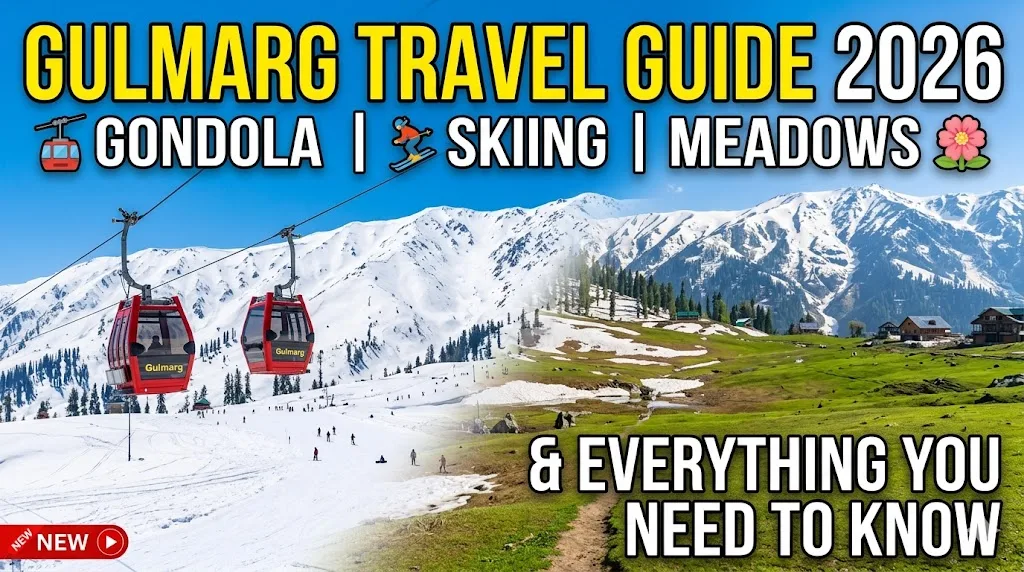
Gulmarg is one of those destinations that works in every season and for almost every type of traveller. In winter it is India’s best ski resort. In summer it is an alpine meadow of extraordinary beauty with one of the world’s highest cable cars. In spring and autumn it sits somewhere between both — quieter, cooler, and often more beautiful than either peak season.
This guide covers everything about Gulmarg — what to do, when to go, how to get there, what the gondola experience is actually like, and the practical details most travel articles leave out.
Where Is Gulmarg
Gulmarg is located in the Baramulla district of Jammu & Kashmir, approximately 50–57 kilometres from Srinagar. It sits at an altitude of 2,650 metres (8,694 feet) in the Pir Panjal Range of the Western Himalayas. The town itself is built around a wide, bowl-shaped meadow — the “marg” of its name — enclosed on three sides by forested slopes and open toward the valley on the fourth.
The name Gulmarg comes from two Kashmiri words — “Gul” meaning flower and “Marg” meaning meadow. In summer when the wildflowers are in bloom, the name makes complete sense.
How to Reach Gulmarg
From Srinagar (most common): The drive from Srinagar to Gulmarg takes 1.5 to 2.5 hours depending on traffic and road conditions. The distance is approximately 50–57 kilometres via the Tangmarg route. The road passes through apple orchards and pine forests before the steep climb begins at Tangmarg — the last major town before Gulmarg.
Private taxis from Srinagar cost approximately ₹1,500–₹2,000 one way. If staying in Gulmarg for multiple nights, most hotels can arrange pickup. Shared sumos from Parimpora bus stand in Srinagar to Tangmarg cost ₹100–₹150, from where chain taxis (vehicles with snow chains in winter) run to Gulmarg for an additional ₹100–₹200 per seat.
In winter (November–March): Beyond Tangmarg, the road can become icy and snow-covered. Regular vehicles without snow chains are not permitted beyond Tangmarg during heavy snow. Chain taxis — locally modified vehicles with tire chains — operate this section. If driving yourself, ensure your vehicle has snow chains before proceeding beyond Tangmarg in winter months.
By air: The nearest airport is Srinagar International Airport (SXR), approximately 58 kilometres from Gulmarg. Direct flights from Delhi, Mumbai, Bangalore, and other major cities land here daily.
By train: No direct train service to Gulmarg. The nearest major railhead is Jammu Tawi, approximately 290 kilometres away. From Jammu, hire a taxi or take a bus to Srinagar, then proceed to Gulmarg.
The Gulmarg Gondola — Everything You Need to Know
The Gulmarg Gondola is the main attraction for most visitors — and rightfully so. It is one of the highest cable cars in the world, running in two phases to a maximum altitude of approximately 3,980 metres at Apharwat Peak.
Gondola Ticket Prices 2026 (approximate):
| Ticket Type | Adult | Child (5–12 years) |
|---|---|---|
| Phase 1 only (Kongdori) | ₹740 | ₹450 |
| Phase 2 only (Apharwat) | ₹920 | ₹580 |
| Phase 1 + Phase 2 combined | ₹1,900 | ₹1,030 |
| Children under 5 | Free | — |
Prices are subject to revision — always verify current rates at the official booking portal before visiting.
Book online: etickets.jammukashmircablecar.com
Online advance booking is strongly recommended during peak season (May–June, December–January). Walk-in queues can mean 2–4 hour waits on busy days.
Phase 1 — Base to Kongdori (2,650m to 3,050m): The first phase runs from the Gulmarg base station to Kongdori — a 10-minute ride through pine forests. Kongdori is a wide, open bowl with panoramic mountain views, a small food area, horse riding, and in season, snow activities. This phase alone is worth doing even if you do not continue to Phase 2.
Phase 2 — Kongdori to Apharwat Peak (3,050m to 3,980m): The second phase continues from Kongdori to Apharwat Peak — a further 10-minute ride through increasingly dramatic alpine terrain. At Apharwat, the views on a clear day are extraordinary — Nanga Parbat (8,126m) is visible on the northwest horizon, and the 360-degree panorama of the Himalayan and Pir Panjal ranges is unmatched anywhere else in J&K accessible by cable car.
Snow is present at Apharwat almost year-round — even in July and August, the upper ridge holds permanent snow fields.
Phase 2 closures: Phase 2 can be closed without notice due to high winds or weather. If you arrive and Phase 2 is closed, Phase 1 operates independently. This happens regularly — do not plan your entire trip around Phase 2 being available.
Things to Do in Gulmarg
Summer (May–October)
Walking and hiking in the meadow: The Gulmarg meadow itself is approximately 3 kilometres in circumference. Walking around it at a leisurely pace takes about an hour. The meadow is flat, well-grassed, and surrounded by forested slopes on all sides. Simply walking here — away from the gondola crowds — is one of the most pleasant experiences Gulmarg offers.
Khilanmarg: A meadow located 6 kilometres from Gulmarg town, accessible on foot or horseback. The walk up takes about 1.5–2 hours through pine forest and opens into a wide meadow with views of the Nanga Parbat range. Khilanmarg holds snow until May or June. The views from here, looking back down toward Gulmarg and across the valley, are exceptional.
Strawberry Valley: A lesser-known meadow approximately 4 kilometres from Gulmarg. Quieter than the main areas, with a small stream running through it and wildflowers in summer. Worth visiting if you want to escape the main tourist concentration.
Gulmarg Golf Course: One of the highest and longest golf courses in the world — 6,200 metres at an altitude of 2,650 metres. Operated by J&K Tourism, the course is open from May to November. Equipment hire is available. Even if you do not play, walking past the course offers good views of the surrounding landscape.
Maharani Temple: A small Hindu temple at the edge of the meadow, built by Maharani Mohini Bai Sisodia in 1915. The temple is dedicated to Lord Shiva. A 15-minute walk from the gondola base, it is quiet and well-maintained.
Alpather Lake: A glacial lake approximately 13 kilometres from Gulmarg, accessible via a trek from Apharwat Peak. The lake remains frozen until June and sits in a high-altitude bowl surrounded by peaks. The trek from Apharwat (after the Phase 2 gondola) takes 2–3 hours return. Not suitable for first-time trekkers without a guide.
Winter (December–March)
Skiing: Gulmarg is India’s premier ski destination — the only resort in the country with gondola-accessed high-altitude skiing. The ski area spans from the Kongdori bowl to the Apharwat ridge, with runs for beginners through to advanced skiers. Ski rental, ski school instruction, and guided skiing are all available at the resort.
The season typically runs from late December to early March depending on snowfall. January and February are the most reliable months for snow coverage.
Snowboarding: Snowboards are available for hire at the resort. The terrain suits intermediate to advanced snowboarders particularly well — the Kongdori bowl and the off-piste terrain above it are the best areas.
Snow activities at Kongdori: Even without skiing, Kongdori in winter offers sledging, snow trekking, and snowman building. These activities are accessible to anyone who takes Phase 1 of the gondola.
Where to Stay in Gulmarg
Accommodation in Gulmarg ranges from basic guesthouses in the town to mid-range hotels and a small number of higher-end properties.
In Gulmarg town: Staying in Gulmarg itself means you wake up in the meadow, can walk to the gondola, and experience the destination without commuting. Rates are significantly higher than Srinagar. Mid-range options cost ₹3,000–₹8,000 per night; budget guesthouses from ₹1,200–₹2,500.
In Tangmarg: The town 13 kilometres below Gulmarg has more budget accommodation options and lower prices. The daily drive up to Gulmarg takes 20–30 minutes. Good option for travellers on a tight budget who want to spend full days in Gulmarg.
Booking in peak season: Book at least 4–6 weeks in advance for December–January and May–June. Last-minute availability is limited and prices are highest.
Practical Tips
Altitude awareness: Gulmarg is at 2,650 metres — Apharwat Peak at 3,980 metres. Some visitors experience mild altitude symptoms (headache, light-headedness) at Apharwat, especially if travelling directly from sea level. Drink water, move slowly, and descend if symptoms worsen.
Clothing for Apharwat: Even in July, the temperature at Apharwat Phase 2 can be 5–10°C. A warm jacket, gloves, and windproof layer are essential regardless of season. In winter, full ski gear is necessary.
Photography: The morning light at Gulmarg (before 9 AM) is the best for photography — clear skies, long shadows, and the meadow before the crowds arrive. Apharwat in clear weather (typically morning before cloud builds) gives the best views.
Pony rides: Horse riding is available throughout the meadow and toward Khilanmarg. Agree on price, destination, and duration clearly before mounting. Standard rate to Khilanmarg and back is approximately ₹800–₹1,200.
Food: Gulmarg has several restaurants and dhabas around the main meadow area. Food is basic — rice, dal, roti, some Kashmiri dishes — and prices are higher than Srinagar. Carrying snacks and water from Srinagar saves money.
Best Time to Visit Gulmarg
| Season | Experience | Suitable For |
|---|---|---|
| December–February | Heavy snow, skiing | Skiing, snowboarding, snow activities |
| March–April | Melting snow, spring beginning | Photography, quiet meadow walks |
| May–June | Green meadows, gondola fully open | Families, first-time visitors, gondola |
| July–August | Full green, wildflowers, mild monsoon | Nature lovers, budget travellers |
| September–October | Autumn colours, cool weather, clear skies | Trekking, photography, honeymoons |
| November | First snowfall, very quiet | Off-peak, photography |
Published by VisitJK — honest travel guides for Jammu & Kashmir. Last updated May 2026.

Rahul Naik is a Jammu & Kashmir local who has spent years exploring the Kashmir Valley, Jammu region, and high-altitude areas of the Union Territory. He has personally visited every major destination covered on VisitJK — from Dal Lake houseboats to Gulmarg slopes to the remote villages of the Gurez Valley. VisitJK is built on that firsthand experience — honest, practical travel content written for visitors who want real information, not brochure language.