
Five days is the minimum time needed to experience Kashmir properly. It is enough to cover the three main destinations — Srinagar, Gulmarg, and Pahalgam — without rushing, and leaves room for one or two unplanned hours of just sitting somewhere beautiful without checking the time.
This itinerary is built for first-time visitors who want to see the highlights without the exhaustion of trying to do everything. It works for couples, families, and solo travellers. It is realistic — distances, driving times, and activity durations are based on actual conditions, not optimistic estimates.
Before You Start — Practical Basics
Base: Srinagar is your base for all 5 days. You return here each night rather than moving between hotels — this saves packing and unpacking time and keeps logistics simple.
Transport: Hire a private cab with driver for the full 5 days. This is the most practical option — rates range from ₹3,500 to ₹5,000 per day depending on vehicle type and season. Your hotel or houseboat can arrange a reliable driver, or book through a local travel agent before arriving.
Accommodation: Stay on a Dal Lake houseboat for at least 2–3 nights if budget allows — it is one of the defining Kashmir experiences. For budget travellers, guesthouses around Dal Lake offer good value.
Booking essentials: Book your Gulmarg Gondola tickets online in advance (especially Phase 2 — Apharwat Peak). In peak season these sell out. Book at least 3–5 days before your Gulmarg day.
Day 1 — Arrival in Srinagar & Dal Lake
Morning — Arrival Arrive at Srinagar Airport. Most flights from Delhi arrive in the morning. Transfer to your houseboat or hotel on Dal Lake. Check in, freshen up, and take your first proper look at the lake.
If you are staying on a houseboat, your host will likely offer you a cup of kahwa (Kashmiri saffron tea) on arrival. Accept it. This is the correct way to begin a Kashmir trip.
Afternoon — Shikara Ride on Dal Lake After settling in, take a shikara ride on Dal Lake. The best time is late afternoon when the light softens and the mountains reflected in the water look their sharpest. A standard shikara ride lasts 1–2 hours and costs ₹500–₹800 per hour (negotiate before boarding — agree on the price, duration, and route clearly).
Ask your shikara man to take you through the floating vegetable gardens — plots of vegetables grown on mats of intertwined weeds floating on the lake surface. This is a genuinely unique agricultural system found almost nowhere else in the world.
Evening — Lal Chowk and Old City Drive to Lal Chowk — Srinagar’s commercial centre — for an evening walk. The area around the clock tower and the lanes leading toward Residency Road are lively in the evenings. This is where to buy dry fruits (walnut, almonds, apricots — J&K produces some of India’s best), saffron, and Kashmiri handicrafts at market prices rather than tourist prices.
Have dinner in the old city — the lanes around Jama Masjid have local restaurants serving Kashmiri food at non-tourist prices.
Overnight: Houseboat or hotel on Dal Lake.
Day 2 — Srinagar Sightseeing
Morning — Mughal Gardens Start early (by 8 AM) at the Mughal Gardens before the day crowds arrive.
Nishat Bagh first — the largest of the three main Mughal gardens, built in 1633 by Asif Khan (brother of Noor Jahan). Twelve terraces descend from the hillside toward Dal Lake. In spring, the flower beds are in full colour. In autumn, the chinar trees turn gold and red. In any season, the views across the lake from the upper terraces are excellent.
Shalimar Bagh is 3 kilometres further along the lake embankment — the oldest of the Mughal gardens (built 1619 by Emperor Jahangir). Slightly more formal in layout than Nishat. The fountains are occasionally operational.
Chashme Shahi is the smallest of the three but sits highest on the hillside — better views, fewer visitors.
Allow 45 minutes to 1 hour per garden. You do not need to rush through them.
Late Morning — Shankaracharya Temple Drive to Shankaracharya Hill — a rocky outcrop rising about 300 metres above Srinagar. The temple at the top is dedicated to Lord Shiva and is believed to be over 2,500 years old in its origins. The climb takes 20–25 minutes. The view from the top — Dal Lake, the city, the valley, the mountains enclosing it — is the best panoramic view of Srinagar.
Afternoon — Hazratbal Shrine The Hazratbal Shrine on the western bank of Dal Lake is the most significant Muslim shrine in Kashmir. The white marble domed structure is serene and well maintained. The shrine houses a sacred relic — the Moi-e-Muqqadas (a hair of the Prophet Muhammad, peace be upon him). Dress modestly and remove footwear before entering the complex.
Late Afternoon — Local Market Spend an hour in the local handicrafts market. The best concentrated area for genuine Kashmiri handicrafts — pashmina, kani shawls, papier-mâché, woodwork, chain stitch embroidery — is in the old city near Lal Chowk. Be prepared to bargain and to walk away if prices seem inflated.
Evening: Return to Dal Lake. Watch the sunset from your houseboat or the lake embankment.
Overnight: Houseboat or hotel, Dal Lake.
Day 3 — Gulmarg
Morning — Early Departure (7:30 AM) Leave Srinagar early. The drive to Gulmarg takes approximately 1.5 hours (50 kilometres via Tangmarg). Leaving early means arriving before the crowds build and getting on the gondola early.
Gulmarg Gondola — Phase 1 (Kongdori) The gondola Phase 1 runs from the base at approximately 2,650 metres to Kongdori at about 3,050 metres. The ride takes around 10 minutes. From Kongdori you have excellent views of the surrounding Himalayan range and access to horse riding, snow activities (in winter and spring), and walking trails.
Gulmarg Gondola — Phase 2 (Apharwat Peak) If you have booked Phase 2 tickets in advance, continue from Kongdori to Apharwat Peak at approximately 3,980 metres. This is the highlight of Gulmarg. At this altitude, the views extend across multiple mountain ranges. Snow is present at Apharwat almost year-round — even in August, the upper ridge holds snow.
Note: Phase 2 can be closed due to weather without notice. If it is closed on your day, Phase 1 alone is still worthwhile.
Afternoon — Gulmarg Meadow After the gondola, spend time in the Gulmarg meadow itself. In summer this is a wide open space of grass and wildflowers, ideal for walking and photography. Horse riding across the meadow is available (agree on price and duration before mounting).
The Maharani Temple — a small Hindu temple built by the Maharani of Kashmir in the early 20th century — is at the edge of the meadow, a 15-minute walk from the gondola base.
Have lunch at one of the dhabas or restaurants in Gulmarg town. Food options are basic but functional — rice, dal, roti, some Kashmiri dishes.
Late Afternoon — Return to Srinagar Drive back by 4–5 PM. The evening light on the drive back through the forested road from Tangmarg to Srinagar is pleasant.
Overnight: Houseboat or hotel, Dal Lake.
Day 4 — Pahalgam
Morning — Early Departure (7 AM) Pahalgam is 95 kilometres from Srinagar — approximately 2.5 hours drive. Leave early to make the most of the day.
The drive itself is scenic — the road follows the Jhelum River for much of the route, passing through the Awantipora area (where you can see the ruins of ancient Hindu temples from the 9th century AD, visible from the road).
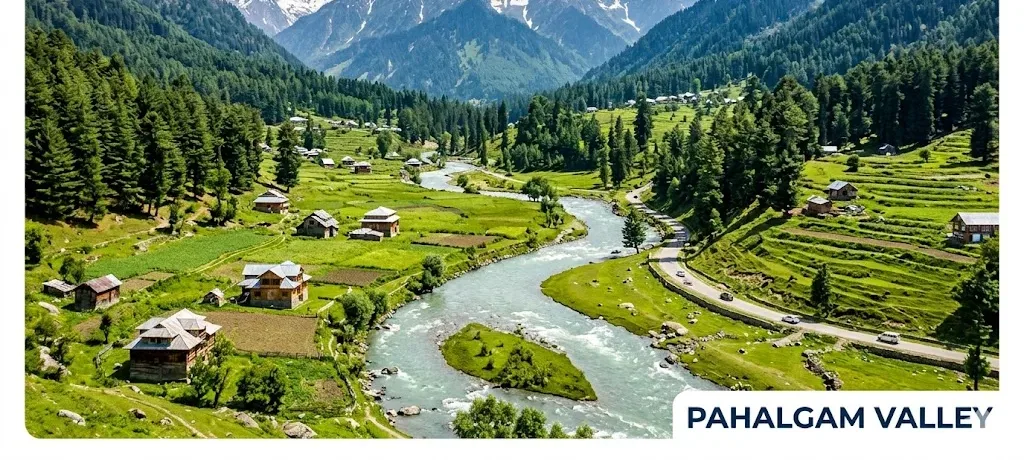
Betaab Valley Arrive in Pahalgam town and continue directly to Betaab Valley — 15 kilometres further up the road. This wide meadow enclosed by forested mountains with the Lidder River running through it is best experienced in the morning before the day trippers arrive from Srinagar. Walk along the river, sit on the grass, take your time.
Aru Valley On the return from Betaab, stop at Aru Valley — 12 kilometres from Pahalgam in a different direction. Quieter and less visited than Betaab, Aru is a grassland valley with the wide open quality of a high-altitude meadow. The walk from the road into the valley takes about 20–30 minutes and is completely flat.
Afternoon — Pahalgam Town and Lidder River Return to Pahalgam town for lunch. The Lidder River runs right through the town — after lunch, walk along the river bank. Horse riding is available along the river and toward the upper meadows.
If time and interest allow, the 3-kilometre walk to Baisaran (a meadow above Pahalgam sometimes called “Mini Switzerland”) is worth doing. It is accessible only on foot or horseback — no vehicles. The views from Baisaran back toward Pahalgam and the valley below are excellent.
Evening — Return to Srinagar Leave Pahalgam by 4 PM to reach Srinagar before dark. The drive back takes 2–2.5 hours.
Overnight: Houseboat or hotel, Dal Lake.
Day 5 — Departure Day
Morning — Final Srinagar Time Use the morning for anything you did not get to earlier — another shikara ride, a return to the old city, or simply sitting on the houseboat deck with a final cup of kahwa watching the lake.
Mid-Morning — Souvenir Shopping If you have not already done your shopping, the area around the Boulevard Road along Dal Lake has numerous handicraft shops. For better prices, the lanes off Lal Chowk and the old city markets are more reliable. Main items worth buying from Kashmir: pashmina (verify authenticity — real pashmina is soft, warm, and expensive; anything very cheap is likely not genuine), walnuts and dried apricots, saffron (buy from a reputed spice shop, not from street vendors), Kashmiri kahwa tea, and papier-mâché items.
Afternoon — Departure Transfer to Srinagar Airport for your onward flight. Srinagar Airport is approximately 15–20 minutes from Dal Lake under normal traffic conditions.
Budget Estimate — 5 Days Kashmir (Per Person)
| Item | Budget Option | Mid-Range |
|---|---|---|
| Accommodation (5 nights) | ₹5,000 – ₹8,000 | ₹12,000 – ₹25,000 |
| Private cab (5 days) | ₹17,500 – ₹20,000 | ₹20,000 – ₹25,000 |
| Gulmarg Gondola (Phase 1+2) | ₹900 per person | ₹900 per person |
| Meals (5 days) | ₹3,000 – ₹5,000 | ₹6,000 – ₹10,000 |
| Shikara rides | ₹1,000 – ₹1,500 | ₹1,500 – ₹2,500 |
| Entry fees and activities | ₹500 – ₹1,000 | ₹1,000 – ₹2,000 |
| Shopping | Variable | Variable |
| Total (approx, excluding flights) | ₹28,000 – ₹36,000 | ₹42,000 – ₹65,000 |
Note: These are approximate figures for the April–June and September–October peak windows. Off-peak travel (July–August, November, March) will be 15–25% lower on accommodation.
Tips for This Itinerary
Do not overplan Day 1. Arrival days always take longer than expected. Keep the first afternoon light — a shikara ride and an evening walk is enough.
Gulmarg on a weekday. If your trip timing is flexible, do Gulmarg on a Tuesday, Wednesday, or Thursday — gondola queues are significantly shorter than on weekends.
Carry cash. ATMs in Pahalgam and Gulmarg can run out of cash during peak season. Withdraw sufficient cash in Srinagar before leaving for day trips.
Dress in layers. Srinagar in summer is warm but Gulmarg at 4,000 metres is cold regardless of season. A warm jacket, gloves, and a hat are needed for the Phase 2 gondola even in July.
Respect local customs. Kashmir is predominantly Muslim. Dress modestly when visiting shrines and mosques. Ask permission before photographing people.
Frequently Asked Questions — 5 Days Kashmir Itinerary
Published by VisitJK — honest travel guides for Jammu & Kashmir. Last updated May 2026.

Rahul Naik is a Jammu & Kashmir local who has spent years exploring the Kashmir Valley, Jammu region, and high-altitude areas of the Union Territory. He has personally visited every major destination covered on VisitJK — from Dal Lake houseboats to Gulmarg slopes to the remote villages of the Gurez Valley. VisitJK is built on that firsthand experience — honest, practical travel content written for visitors who want real information, not brochure language.