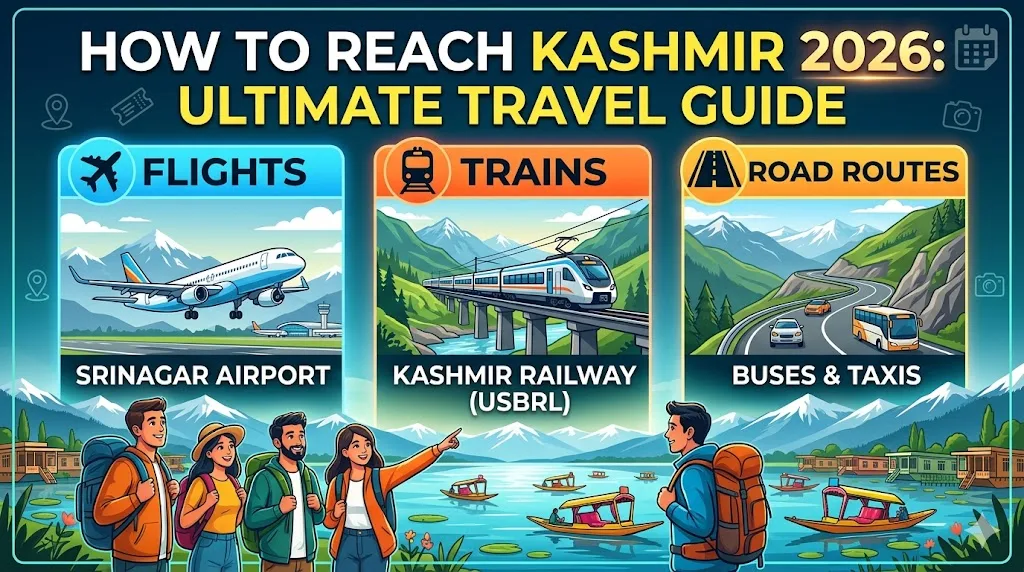
Kashmir has never been easier to reach than it is right now. For decades, the valley was accessible only by air or by a long, often unpredictable drive over the Jammu-Srinagar highway. That changed for good after the Udhampur-Srinagar-Baramulla Rail Link (USBRL) was completed, putting Srinagar on India’s railway map for the first time in history. Add to that dozens of daily flights and a much-improved national highway, and you now have three genuinely good ways to plan your journey to the Kashmir valley.
This guide breaks down every option — flights, trains, and road travel — with real timings, approximate fares, and practical advice so you can pick the route that suits your budget, schedule, and sense of adventure.
Quick Overview: Which Route Should You Choose?
- Short on time, flying from far away? Take a flight to Srinagar International Airport (SXR).
- Coming from Delhi, Punjab, or Jammu and want a scenic, comfortable journey? The new Vande Bharat Express is the best middle-ground option.
- Road-tripping or traveling with a group and lots of luggage? Drive or take a bus via the Jammu-Srinagar National Highway.
Most travelers now combine two of these — for example, flying into Jammu or taking the train to Srinagar, then using road transport for sightseeing within the valley.
1. Flying to Kashmir (Srinagar Airport – SXR)
Flying remains the fastest and most popular way to reach Kashmir, especially for travelers coming from outside North India.
Key Airports
Srinagar International Airport (Sheikh ul-Alam International Airport) is the only major airport serving the valley. It is well connected to:
- Delhi (1.5 hours, multiple daily flights)
- Mumbai (direct and connecting flights)
- Bengaluru, Hyderabad, Chennai (mostly via Delhi)
- Jammu (short 30-40 minute hop)
- Chandigarh, Ahmedabad, Pune, Kolkata (seasonal or connecting)
Fares and Timing
Round-trip fares from Delhi typically range from ₹4,000 to ₹9,000 depending on season and how far in advance you book. Prices spike sharply during peak season (April-July) and around the winter snowfall window (December-February), so booking 3-4 weeks ahead usually saves a meaningful amount.
What to Know Before You Fly
- The airport functions as a joint civilian-military facility, so security checks are more thorough than at typical Indian airports. Arrive at least 2.5-3 hours before domestic departures.
- Carry a valid photo ID; it’s checked multiple times during the process.
- Hand baggage rules can be slightly stricter — check your airline’s policy on liquids and power banks in advance.
- Flights are occasionally delayed or cancelled due to weather, particularly in winter. If you’re visiting in December-February, build a buffer day into your itinerary.
- The airport sits about 14 km from Srinagar city (Lal Chowk/Dal Lake area), roughly a 30-40 minute taxi ride.
2. Taking the Train to Kashmir (The New Vande Bharat Route)
This is the single biggest change in how people travel to Kashmir, and it deserves its own section. After nearly 127 years of effort, the Udhampur-Srinagar-Baramulla Rail Link was completed, connecting the Kashmir Valley to the Indian railway network for the first time. The line includes the Chenab Bridge, the world’s highest railway arch bridge, standing taller than the Eiffel Tower above the riverbed.
How the Train Works Today
The Vande Bharat Express now runs between Jammu Tawi and Srinagar, an extension that took effect from March 1, 2026, cutting the journey to around five hours end to end. Before this extension, the train operated only between Shri Mata Vaishno Devi Katra and Srinagar, covering that shorter stretch in about three hours, less than half the six to seven hours road travel used to take.
The train makes a stop at Banihal, with an additional short halt added at Reasi station to serve pilgrims visiting Vaishno Devi and tourists heading to see the Chenab Bridge.
These are not ordinary passenger trains. The Vande Bharat sets used on this route are specially built for extreme winter conditions, fitted with advanced heating systems, thermally insulated lavatories, heated windshields, and de-icing technology — essential given the snow and sub-zero temperatures the line passes through in the Pir Panjal range.
Fares
Chair Car fares are priced between roughly ₹665 and ₹715 depending on demand and booking category, with Executive Chair Car tickets costing more for extra legroom and service. This makes the train dramatically cheaper than flying while still being fast and comfortable.
How to Book
Tickets can be booked through the IRCTC website or app like any other Indian Railways ticket. Because demand has been extremely high since launch — most seats sell out within hours of release — book as early as the 60-day advance reservation window allows, especially for travel during peak tourist season.
Why This Route Is Worth Considering
Beyond the practical benefits, the journey itself has become an attraction. Crossing the Chenab Bridge, threading through dozens of tunnels carved into the Pir Panjal mountains, and watching the landscape shift from the plains of Jammu to the snow-dusted peaks of the valley is, for many travelers, one of the highlights of the trip rather than just a means of getting there.
3. Driving or Taking a Bus to Kashmir (Road Route)
For travelers who want flexibility, scenic stops, or are traveling in a group, the road route via the Jammu-Srinagar National Highway (NH44) remains a solid option.
The Main Route
Delhi → Jammu → Udhampur → Banihal (via Jawahar Tunnel or the newer Banihal-Qazigund tunnel) → Anantnag → Srinagar
The full drive from Delhi to Srinagar covers roughly 800 km and typically takes 18-20 hours if done in one stretch, which is why most travelers break the journey overnight in Jammu.
Jammu to Srinagar Specifically
This shorter 270 km stretch usually takes 7-9 hours by road depending on traffic, weather, and landslide-related closures, which are common during monsoon and winter months. This is precisely the stretch the new train has made dramatically faster and more reliable.
Buses
J&K State Road Transport Corporation (JKSRTC) and several private operators run regular bus services from Jammu, and seasonally from Delhi and Chandigarh, to Srinagar. Buses are the most budget-friendly option but take the longest and are more exposed to weather-related delays.
Self-Drive and Taxis
Shared taxis (Sumo/Innova) are widely available from Jammu’s Bus Stand/Janipur taxi stand directly to Srinagar, and are a popular middle option between bus and private car. If you’re self-driving from outside J&K, check road conditions in real time before departure — the highway is occasionally closed for landslide clearance, especially around Ramban and Banihal.
Things to Keep in Mind on the Road Route
- Winter driving requires snow chains in some stretches and is best avoided unless you’re experienced with mountain driving.
- Network connectivity drops in several stretches through the tunnels and mountain passes.
- Fuel up in Udhampur or Jammu, as options thin out in the higher reaches.
- Permits are not required for the Jammu-Srinagar highway itself, but certain border-adjacent and high-altitude areas within Kashmir do require permits — worth checking separately before finalizing your itinerary.
Comparing the Three Options
| Factor | Flight | Train (Vande Bharat) | Road |
|---|---|---|---|
| Speed | Fastest (1.5 hrs from Delhi) | Fast (5 hrs Jammu-Srinagar) | Slowest (7-20+ hrs) |
| Cost | Higher, variable | Low and fixed | Low to moderate |
| Comfort | High | High, scenic | Variable |
| Weather Risk | Moderate (fog/snow delays) | Low (winter-proofed) | High (landslides, snow) |
| Best For | Long-distance travelers, short trips | Budget + comfort seekers, scenic-route lovers | Groups, flexible itineraries, road-trippers |
Sample Travel Plans
Fastest option: Fly Delhi → Srinagar directly (1.5 hours), ideal if you have limited vacation days.
Best value option: Fly or take an overnight train/bus to Jammu, then take the Vande Bharat Express onward to Srinagar — comfortable, scenic, and significantly cheaper than flying the whole way.
Most adventurous option: Drive the full Jammu-Srinagar highway, stopping at Patnitop, Banihal, and Anantnag along the way to break up the journey and see parts of J&K most tourists skip entirely.
Final Tips Before You Travel
- Check the season: winter (December-February) brings snow-related disruptions to flights and roads alike, though the new winter-proofed trains are far more reliable during this period.
- Always keep a buffer day in your itinerary if your trip is tightly scheduled around return flights from Srinagar.
- Carry a valid photo ID at every stage — it’s checked at airports, occasionally on the highway, and while booking certain permits within the valley.
- If you’re combining a Vaishno Devi visit with your Kashmir trip, the Katra stop on the new rail line makes it easy to do both in a single journey.
Kashmir’s connectivity has transformed dramatically in the last couple of years. Whether you choose the speed of a flight, the comfort and scenery of the new train, or the flexibility of the open road, getting to the valley is no longer the hard part of the trip — figuring out how to fit in everything you want to see once you’re there is.

Rahul Naik is a Jammu & Kashmir local who has spent years exploring the Kashmir Valley, Jammu region, and high-altitude areas of the Union Territory. He has personally visited every major destination covered on VisitJK — from Dal Lake houseboats to Gulmarg slopes to the remote villages of the Gurez Valley. VisitJK is built on that firsthand experience — honest, practical travel content written for visitors who want real information, not brochure language.