There’s a particular kind of cold that settles over Srinagar once Chillai Kalan begins — the forty harshest days of the Kashmiri winter, when the Dal Lake edges freeze and breath turns visible in the morning air. And there’s exactly one smell that cuts through that cold and pulls people out of their warm quilts before sunrise: the smell of Harisa simmering in an earthen pot somewhere in the old city.
If you’re searching for what Kashmiri Harisa actually is, why locals queue for it at dawn, and where to find the best plate of it in 2026, this guide covers everything — the history, the ingredients, the cooking process, the best neighborhoods to try it in, and why this single dish has survived in Kashmir for over six centuries.
What Exactly Is Kashmiri Harisa?
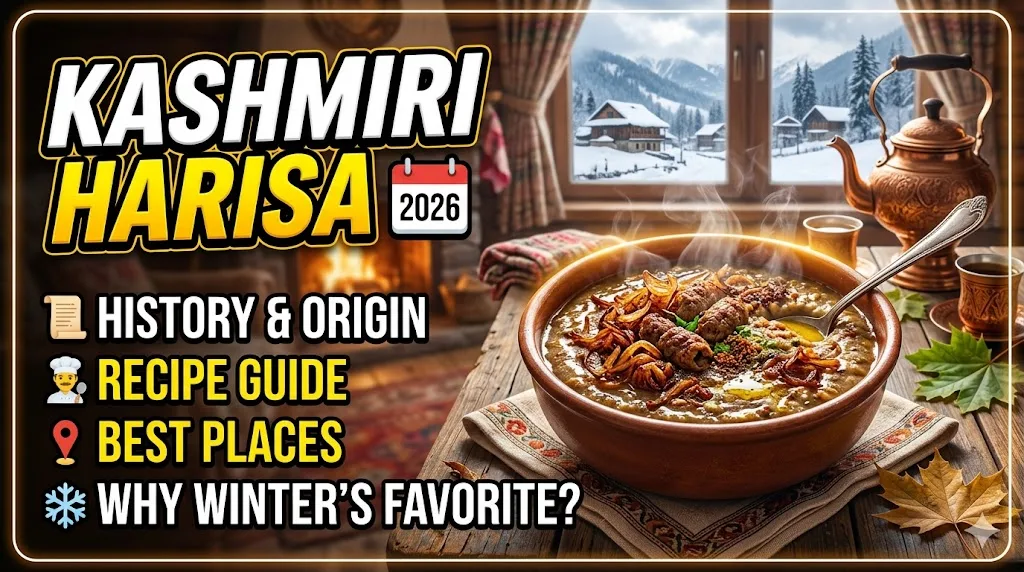
Harisa is a slow-cooked mutton and rice preparation that’s been a winter breakfast staple in Srinagar for generations. Unlike the chilli-based North African condiment that shares its name, Kashmiri Harisa is something else entirely — a thick, pale caramel-coloured paste with a texture somewhere between a porridge and a meat stew, made by cooking pounded mutton and rice together for nearly an entire night until the meat dissolves into the grain.
It isn’t spicy. It isn’t fancy. What it is, instead, is deeply warming — rich in protein and fat, designed almost perfectly to fuel a body through a sub-zero Kashmiri morning. That’s precisely why it’s eaten as breakfast rather than a dinner dish; people line up at Harisa shops right after the Fajr prayer and eat it while it’s still steaming, often standing outside in the cold with a bowl in hand.
A Dish With Roots in Persia and Central Asia
The story of how Harisa reached Kashmir is one of cultural exchange stretching back centuries. Most historians trace similar wheat-or-rice-and-meat preparations to Persian, Arab, and Central Asian culinary traditions, where slow-cooked, calorie-dense food made practical sense in cold climates. In fact, a preparation resembling Harisa appears in a Arabic cookbook dating back roughly a thousand years, long before it ever reached the Kashmir valley.
The dish is widely believed to have entered Kashmir in the fourteenth century, carried along with the arrival of the Persian Sufi saint Mir Syed Ali Hamdani — known locally as Shah-e-Hamdan — who brought with him far more than spirituality. His era introduced Kashmir to Persian art, craftsmanship, and cuisine, and Harisa took root as part of that exchange. A separate account credits a noble named Mirza Hyder Duglat with bringing a more refined version of the recipe from Central Asia in the sixteenth century. Either way, by the time Srinagar’s old city shops began serving it commercially, the dish had already been adapted heavily to local taste — using Kashmiri rice, Kashmiri mutton, and the valley’s own spice blend.
What’s remarkable is how long the commercial tradition has lasted. Several of Srinagar’s Harisa-making families have been running their shops for more than two hundred years, passing recipes and techniques from one generation to the next without writing any of it down — it’s all memory, instinct, and practiced hands.
How Harisa Is Traditionally Made
The preparation is what makes Harisa genuinely special, and it’s almost the opposite of fast food. Here’s the rough process followed by most traditional Harisa makers in Srinagar:
- The base is built overnight. Mutton — often including bone-in cuts for richness — is combined with rice and left to cook slowly over a low, steady flame, traditionally inside an underground earthen pot or vessel called a “deg.” This isn’t a quick simmer; it runs for hours, often close to a full day, until the meat fibres break down completely.
- Constant pounding and stirring. As the rice and meat soften, the mixture is repeatedly beaten and stirred — sometimes by hand with a wooden ladle, sometimes mechanically in larger shops today — until it turns into a smooth, homogenous paste with no visible chunks of meat or grain left.
- The finishing touches. Once the texture is right, the Harisa is served hot, usually drizzled with sizzling mustard oil or ghee, and topped with garnishes like a mutton kebab, or “methi maaz” — a rich, ghee-based preparation made from minced offal and fenugreek. Some shops also offer fried onions as a topping.
- The prized crust. Customers who arrive early enough — generally before mid-morning — sometimes get a portion of “phuher,” the golden-brown crust that forms at the bottom of the cooking pot. It’s considered a delicacy within a delicacy, and regulars often specifically ask for it.
Harisa is almost always eaten with a local bread rather than rice or roti on the side. The traditional pairing is “tchot” or “girda,” a round, slightly chewy Kashmiri bread baked fresh in local bakeries — its texture is perfect for soaking up the rich paste.
Where To Find The Best Harisa in Srinagar
If you’re visiting Srinagar in winter 2026 and want an authentic plate, downtown Srinagar — the old city — is where you need to head. The neighborhoods most associated with the oldest and most respected Harisa shops include:
- Aali Kadal – home to what’s considered one of the oldest Harisa establishments in the city, with a legacy running over two centuries.
- Fateh Kadal – another old-city locality known for generational Harisa shops.
- Rajouri Kadal – a long-standing hub for Harisa, particularly busy in the early morning hours.
- Maisuma and Sarai Bal – slightly more uptown, but still home to well-regarded shops that draw loyal regulars.
A practical tip: most shops sell out by mid-to-late morning, since the entire batch is cooked overnight in a fixed quantity. If you want the best texture — and a shot at getting the prized “phuher” crust — arriving close to dawn is your best bet. In recent years, a handful of modern cafés around the city have also added Harisa to their menus, making it more accessible to tourists who’d rather not navigate the narrow lanes of the old city before sunrise, though purists will tell you the experience isn’t quite the same.
Why Harisa Matters Beyond the Plate
Harisa isn’t just food in Kashmir — it’s a ritual tied to season, faith, and memory. Eating it after the Fajr prayer during Chillai Kalan is, for many families, as much a part of winter as the snowfall itself. Older Kashmiris often recall childhoods spent saving pocket money for weeks just to afford a single plate, or remember “Harisa saal” — community gatherings organised specifically around the dish, where neighbours and relatives would share a meal together during the coldest part of the year. While those large communal feasts are less common today, the daily ritual of queuing at a shop with a steel bowl, breath visible in the cold morning air, remains a deeply familiar scene in the old city every winter.
There’s also a practical, almost medicinal logic behind the dish that locals still believe in: that a hot, protein-rich meal first thing in the morning helps the body resist the colds and minor illnesses that come with the harsh Kashmiri winter. Whether or not that’s scientifically precise, there’s no denying that a bowl of Harisa, eaten hot with melted ghee on top, does exactly what winter comfort food is supposed to do.
Frequently Asked Questions About Kashmiri Harisa
Is Harisa the same as the North African dish with a similar name?
No. The North African “harissa” is a fiery chilli paste used as a condiment, while Kashmiri Harisa is a savoury mutton-and-rice dish with no chilli heat at all. The names are coincidental cousins at best.
When is the best time of year to try it?
Harisa is a winter-only dish in most shops, typically available from around November through February or March, coinciding with the coldest months in the valley.
What does it taste like?
Expect a rich, savoury, slightly buttery flavour with a soft, almost creamy texture — closer to a hearty meat porridge than anything spicy or sharp.
Can vegetarians eat any version of it?
Traditional Harisa is mutton-based and isn’t typically made in a vegetarian version, since the meat is essential to both its texture and flavour.
Is it healthy?
It’s calorie-dense and rich in protein and fat, which is exactly why it works as winter fuel. It’s best enjoyed in moderation rather than as an everyday meal, especially outside the coldest months.
Final Thoughts
Few dishes manage to carry six hundred years of history, religious ritual, and family tradition inside a single bowl — but Harisa does exactly that. It’s slow food in the truest sense, built on patience, inherited skill, and a climate that demands something warm and substantial before sunrise. If you find yourself in Srinagar this winter, skip the hotel breakfast for one morning, head into the old city before dawn, and try it the way it’s meant to be eaten — standing in the cold, bowl in hand, with the city slowly waking up around you.

Rahul Naik is a Jammu & Kashmir local who has spent years exploring the Kashmir Valley, Jammu region, and high-altitude areas of the Union Territory. He has personally visited every major destination covered on VisitJK — from Dal Lake houseboats to Gulmarg slopes to the remote villages of the Gurez Valley. VisitJK is built on that firsthand experience — honest, practical travel content written for visitors who want real information, not brochure language.