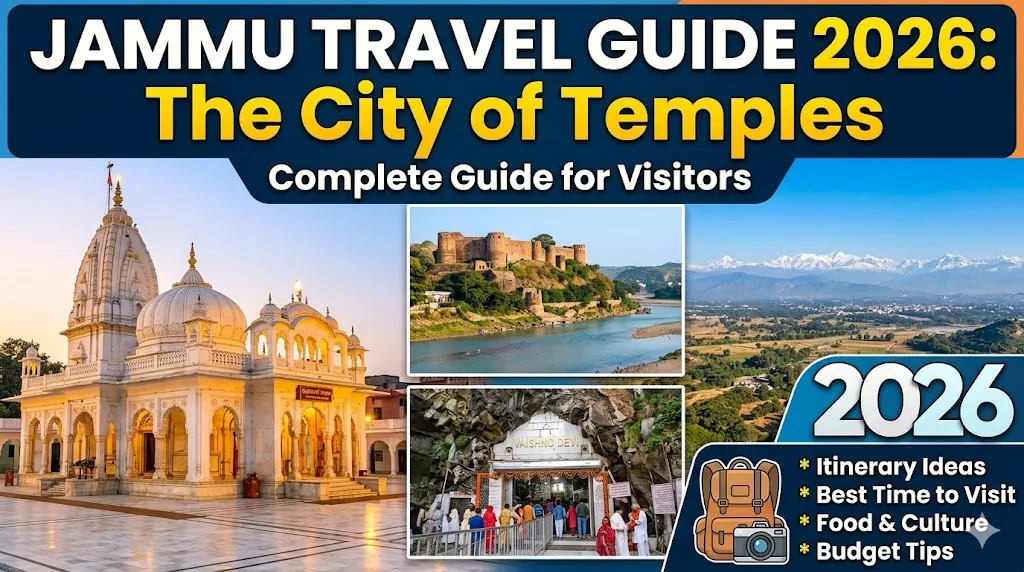
Jammu is almost always the starting point for a J&K trip — most road travellers pass through it, many fly into Srinagar and miss it entirely. This is a mistake. Jammu has its own distinct identity, its own temples, its own food culture, and its own landscape that is completely different from the Kashmir Valley. It is not a gateway to somewhere else — it is a destination in its own right.
This guide covers Jammu city and its surroundings — what to see, what to eat, how to get around, and the day trips from Jammu that most visitors never make.
Jammu — The Basics
Jammu is the winter capital of Jammu & Kashmir and the largest city in the Jammu Division. It sits in the Shivalik hills of the outer Himalayas at an altitude of approximately 327 metres — significantly lower and warmer than the Kashmir Valley. The Tawi River flows through the city.
Jammu has a majority Hindu population and is culturally distinct from the Kashmir Valley — the food, language (Dogri is the primary local language alongside Hindi and Punjabi), temples, and everyday life are different. Understanding this difference is part of understanding J&K as a whole.
How to Reach Jammu
By train: Jammu Tawi Railway Station is one of the best-connected railway stations in the region. Direct trains from Delhi (8–10 hours), Mumbai (26–28 hours), Amritsar (3–4 hours), and other major cities run regularly. The Rajdhani Express, Duronto Express, and Sampark Kranti Express are among the faster services from Delhi. The railway station is in the heart of the city.
By air: Jammu Airport (IXJ) has direct flights from Delhi, Mumbai, and a few other cities. The airport is approximately 7 kilometres from the city centre. Srinagar (SXR) is the more connected airport for the region — many travellers fly into Srinagar and return from Jammu by road (or vice versa) to cover both divisions in one trip.
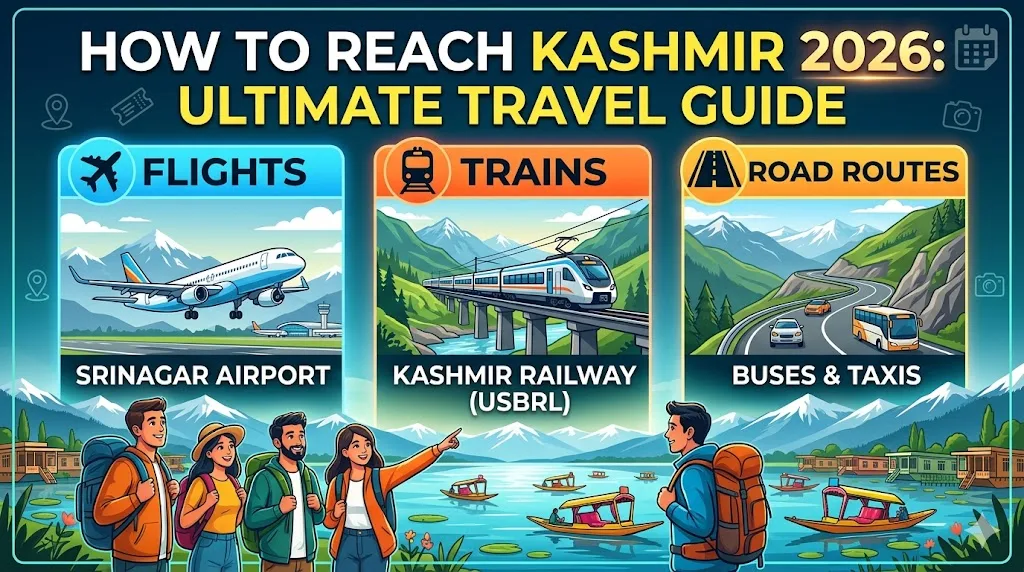
By road: The Jammu–Srinagar National Highway (NH44) is the main road connection between Jammu and the Kashmir Valley. The drive takes 7–9 hours depending on traffic and road conditions. The highway passes through the Banihal tunnel — a 8.5-kilometre tunnel that cuts through the Pir Panjal Range and significantly reduces travel time compared to the old mountain route.
What to See in Jammu City
Vaishno Devi — The Region’s Most Important Shrine
While not in Jammu city itself (the base camp is at Katra, 45 kilometres from Jammu), the Vaishno Devi shrine is the reason millions of pilgrims come to this region every year. The shrine is dedicated to the Hindu goddess Vaishno Devi and is one of the most visited pilgrimage sites in India — over 8 million visitors annually.
The trek from Katra to the main cave shrine is approximately 13–14 kilometres one way. Helicopter service is also available from Katra (limited seats, book well in advance at jammuvaishnodevi.org). The trek passes through dense forest, mountain terrain, and crosses several rivers before reaching the cave shrine at approximately 1,560 metres altitude.
The Vaishno Devi shrine is open year-round. Peak season is Navratri (twice a year — March/April and September/October) when crowds are largest. For a relatively peaceful visit, choose non-festival months.
Yatra registration: All visitors must register for the Vaishno Devi Yatra. Registration is done online at jammuvaishnodevi.org or at Katra. The registration slip is required for entry to the trek route.
Raghunath Temple
Located in the heart of Jammu city near Raghunath Bazaar, this is one of the largest temple complexes in North India. Built by Maharaja Gulab Singh (founder of the Dogra dynasty) in 1835 and completed by his son Maharaja Ranbir Singh, the complex contains seven shrines. The main temple is dedicated to Lord Rama.
The architecture is Dogra-style temple construction — distinct from the South Indian gopuram style and the North Indian nagara style, with its own regional character. The temple museum has artefacts from the Dogra period.
Entry is free. Open from early morning to late evening with a midday break.
Bahu Fort
Bahu Fort sits on a rocky promontory above the Tawi River, approximately 5 kilometres from the city centre. The fort is believed to have been built over 3,000 years ago — the current structure dates largely to the Dogra period (18th–19th century). The fort houses the Bahu Mata temple dedicated to Goddess Kali, which is particularly crowded during the Tuesday “mela” (fair) when thousands of devotees visit.
The fort provides good views over the Tawi River and the city beyond. The gardens below the fort are a popular evening gathering spot for local families.
Mubarak Mandi Palace
The Mubarak Mandi complex was the royal palace of the Dogra rulers — a sprawling group of buildings constructed over several centuries in a mix of Rajput, Mughal, and European architectural styles. The complex is in a state of partial restoration.
The Dogra Art Museum inside the complex houses an important collection of Pahari miniature paintings (the distinctive style developed in the Himalayan foothills), sculptures, weapons, and artefacts from the Dogra period. The museum is one of the better regional museums in J&K and worth an hour.
Entry fee: Nominal. Closed on Mondays.
Amar Mahal Museum
The Amar Mahal Palace — built in 1890 in a French chateau style for Maharaja Amar Singh — sits above the Tawi River with excellent views over the city. Now a museum, it houses the Dogra royal library, a throne room with original furniture, and a significant collection of Pahari paintings. The golden throne on display is one of the more impressive royal artefacts in the region.
Entry fee: Nominal. Photography is restricted inside.
Peer Kho Cave Temple
A cave temple dedicated to Lord Shiva, located beside the Tawi River. The cave is natural and the temple inside it is ancient. The location on the riverbank gives it a peaceful quality despite being in the city. Worth visiting if you have time after the main sites.
Day Trips from Jammu
Patnitop (112 km)
A hill station at 2,024 metres altitude in the Udhampur district, Patnitop is a plateau meadow with views of the Pir Panjal Range. Significantly cooler than Jammu city in summer. In winter, it receives light snowfall. The drive from Jammu takes approximately 2.5–3 hours through the Nathatop pass.
Surinsar-Mansar Lakes (62 km)
Two lakes in the Jammu district considered sacred in Hindu tradition. Mansar Lake is the larger and more visited — surrounded by forest, with a temple on the shore. Boat rides are available. A pleasant half-day trip from Jammu.
Sanasar (120 km)
A meadow at 2,050 metres altitude near Patnitop, Sanasar is known for adventure activities — paragliding, camping, and golf. The meadow setting is beautiful. Accessible as a day trip from Jammu or as a night stay.
Dogra Food — What to Eat in Jammu
Jammu’s food culture is Dogra — distinct from Kashmiri cuisine and worth understanding separately.
Rajma Chawal: While Rajma (kidney beans) and rice is eaten across North India, Jammu’s version using the local Jammu rajma variety — a small, dark red bean grown in the Jammu region — is considered among the finest in India. The rajma here has a different flavour and texture from the larger variety used in Punjab. This is the everyday comfort food of Jammu households and available in most local restaurants.
Khatta Meat: A Dogra specialty — mutton cooked in a tangy, tamarind and anardana (pomegranate seed) based sauce. The sourness of the sauce is the defining characteristic. Not widely known outside Jammu, Khatta Meat is the dish most associated with Dogra cuisine.
Kalari Cheese: A hard, local cheese made in the Udhampur district. It is pan-fried in a dry pan until golden on the outside — the inside remains soft and slightly stringy. Eaten with bread or on its own as a snack. Found at street food stalls and some restaurants in Jammu.
Kalaadi: Similar to Kalari — a local Dogra hard cheese. The two names are used interchangeably in different parts of the region.
Ambal: A sweet-sour pumpkin dish made with tamarind — a Dogra specialty found in traditional Jammu households and some local restaurants.
Maa ki Dal: Whole black lentils slow-cooked overnight — the Jammu version tends to be more simply spiced than the Punjab version. Rich and hearty, eaten with rice or roti.
Where to eat in Jammu: The area around Raghunath Bazaar and the older commercial parts of Jammu city have the most concentrated selection of local restaurants serving Dogra food. The highway dhabas on NH44 as you approach Jammu from the Srinagar direction also serve good Dogra food and are popular with travellers.
Practical Tips for Jammu
Climate: Jammu is significantly hotter than the Kashmir Valley in summer. June–August temperatures regularly reach 40–42°C in the city. If your primary destination is Kashmir, transit through Jammu quickly in summer rather than spending multiple days there. The best time to stay in Jammu is October–March when temperatures are pleasant (15–25°C).
Language: Dogri is the primary local language. Hindi and Punjabi are widely understood. English is spoken in hotels and tourist areas.
Currency: All standard banking facilities available. ATMs throughout the city.
From Jammu to Srinagar by road: The Jammu–Srinagar NH44 can be closed due to landslides or heavy snowfall — particularly in winter and during the monsoon. Check road status before travelling. The JKTRAFFIC app and jktraffic.nic.in provide real-time road status updates.
Jammu as a base: Jammu works well as a base for visiting Vaishno Devi, Patnitop, and the Jammu region. For the Kashmir Valley, Srinagar is the better base.
Best Time to Visit Jammu
| Season | Temperature | Best For |
|---|---|---|
| October–February | 10°C – 25°C | City sightseeing, Vaishno Devi, pleasant weather |
| March–April | 20°C – 32°C | Navratri pilgrimage, spring |
| May | 30°C – 38°C | Hot but manageable, pre-peak |
| June–September | 35°C – 42°C | Very hot — transit only, not recommended for extended stay |
October to February is the best period for visiting Jammu. The city is at its most pleasant and the Vaishno Devi trek is comfortable year-round but particularly good in this window.
Published by VisitJK — honest travel guides for Jammu & Kashmir. Last updated June 2026.
Frequently Asked Questions — Jammu Travel Guide

Rahul Naik is a Jammu & Kashmir local who has spent years exploring the Kashmir Valley, Jammu region, and high-altitude areas of the Union Territory. He has personally visited every major destination covered on VisitJK — from Dal Lake houseboats to Gulmarg slopes to the remote villages of the Gurez Valley. VisitJK is built on that firsthand experience — honest, practical travel content written for visitors who want real information, not brochure language.